Credit Card Options Increase for Vending Operators
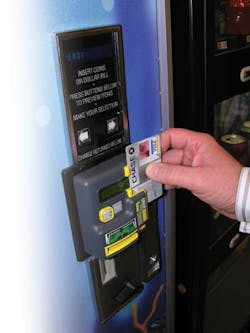
The concept of installing credit/debit card systems in vending machines seems fairly straightforward, but the reality is that these systems have seen very limited deployment in the vending industry. There are several million vending machines in the U.S., yet my research suggests that less than 10,000 of them are equipped to handle credit and debit cards.
My candid assessment is that in the past, technical problems (covered in last month's article) and poor return on investment (because of network and processing fees) have hindered adoption. The good news is that most of the technical problems have been addressed and there is big money trying to make credit cards work in the vending segment. Sooner or later, all vending equipment will eventually take credit cards.
When I say "big money" is trying to make credit cards work in vending, I am referring to the deployment of machines equipped with credit card readers by the largest beverage bottlers. There has been nationwide deployment of cashless vending machines and point-of-sale terminals by MasterCard and USA Technologies.
This represents the impetus of "open" systems, as opposed to "closed" systems. Last month's article reviewed both types of cashless systems.
I spoke to several operators that had deployed credit card solutions in their machines. In general, the systems were cost effective where prices are high, and low commissions justified the added expense. The success was mainly in high price point locations like airports and amusement parks with vend prices at $2 or greater.
Some great examples include high-end glassfront beverage machines that sell 16-ounce soda for $2 a bottle, and higher priced health and energy drinks for $3 or more. The sales lift with credit cards in these deployments was 10 to 30 percent.
Many of these operators were provided the credit card hardware at a highly subsidized cost. These operators found they could cover the communications and per transaction charges based on the sales lift. The jury is still out on whether the upfront $600 hardware costs would have justified the cost of the total solution.
New players enter the fray
Besides the support of MasterCard, several new system providers are also promoting credit card use.
- Automated Vending Technologies is a company that manufactures vending machines as well as a host of vending technologies, including digital touchscreens and cashless payment. The payment solution includes credit cards, bar code cards, and debit cards. The cashless component can be retrofitted to existing machines.
- Heartland Payment Systems will be offering an end-to-end solution for the vending channel. They acquired Debitek (with 20 years of experience providing cashless solutions in vending) in February 2006, and have been working on the solution ever since.
- Isochron has a new solution that involves in-machine hardware and connectivity to support credit cards. Their credit card solution has a display on the credit card reader that supports full-color and advertising.
Thirty five machines in the Atlanta, Ga. airport have Isochron credit card readers with the innovative display solution. Isochron is marketing the solution primarily to larger operators that are using its VendCast solution, which provides machine management and selective remote monitoring of machines. The cost of the VendCast system with credit cards requires a $600 upfront hardware investment and $10 a month in monitoring fees and 5 percent to 10 percent transaction cost, depending on the average vend price and volume.
- Microtronic US recently introduced an in-machine RFID terminal, which communicates not only with Microtronic key/card media but also with the new PayPass contactless credit and debit cards, and with Near Field Communication (NFC)-equipped cellular telephones.
- Solara Technologies is introducing a complete point-of-sale gateway allowing vending operators to process credit, debit and loyalty payments from any location in real-time. The system features reduced processing rates and also includes a closed-circuit, digital video, point-of-sale advertising system and remote machine monitoring.
- Vendors Exchange International Inc.'s Zip cashless system now includes a new replacement board that allows credit and debit card acceptance in older machines, in addition to other features.
How credit card systems work
When installing credit card readers in vending equipment, each terminal must be connected to a public network so the credit card transactions can be authorized. This connection is rarely free, and most often is carried over a cell provider's data network that involves monthly charges that are incurred by the cashless provider.
In addition, there are fees involved in "clearing" the credit card transaction. These fees are passed on to the cashless provider who in turn must pass them on to the vending operator. While several variables determine the total fees, there seems to be a fixed component on a per transaction basis (estimated at 7.5 to 10 cents per vend), and a charge based on percentage of credit/debit sales of 2 percent to 3 percent.
These systems are more cost effective when the vend price is higher. Therefore, wider adoption of credit card systems in vending will depend on:
- Vending operators and bottlers being able to justify higher vend prices (on a par with convenience stores).
- Communications costs continuing to decrease.
- Lower transaction fees from credit card companies and merchant banks.
Largest deployment to date: USA Technologies
USA Technologies has the largest deployment of credit card readers and has worked with several Coke bottlers, Cadbury Schweppes, and numerous vending operators. The system costs about $600 for the hardware, $9.95 per month for network fees (cellular), and 5 percent of the cashless vending transactions as processing fees.
The company's research suggests that consumers spend 32 percent more per transaction when using their credit/debit card, in comparison to cash purchases. Other studies suggest that the higher the vend price, the higher the percentage usage of credit and debit, starting at 19 percent when the vend price is under $1 and topping out at 27 percent at vend prices over $2.50.
Chris Barnes, manager of corporate communications at Cadbury Schweppes Americas Beverages, noted that they have seen anywhere from a 5 percent to 35 percent increase in revenues from machines where USA Technology's e-Port credit/debit systems were installed.
As added benefits, USA Technologies provides customers access to the USA Live Website, and will send operational (DEX) data over their network to the operator's software systems. They currently are doing this with operators that are using Cantaloupe's Seed and Crane Streamware's VendMAX systems.
More partnerships emerge
TNS is the largest payment gateway in credit card processing, and has an ongoing partnership with Pepsi to provide credit cards in Pepsi branded vending equipment. The system is installed in the machine near the baggage claim area of the Oakland Airport in Oakland, Calif.
The details between TNS and Pepsi's agreement are confidential.
Debitek, now fully owned by Heartland Payment Systems, will be offering a full "end to end" solution this year. Stacey Cooper, director of product management, noted that "at Heartland, we eliminate the middleman, because we offer the in-machine equipment, we are the gateway, and we are our own merchant processor."
While he did not have specific pricing available, he suggested that the costs of doing transactions in vending "vary based on a number of factors, including volume, location, and average vend price. However, if our services are used at the foodservice POS terminals, we will roll the vending costs into the same contract at a lower price."
The Debitek solution will initially use Ethernet or Wi Fi for connectivity, so presumably the communication costs will be favorable compared to a cellular solution.
There is no doubt in my mind that cashless systems offer several opportunities for increased profitability in vending today.
Cashless gives vendors a new benefit to offer
Vending operators should think about including cashless systems as part of the bidding process. Operators should use cashless to justify higher prices and take the focus off of low prices and high commissions.
Credit/bank debit card systems work today in high price point/high volume locations, and operator costs will be driven down by competition, innovation, and the eagerness of the entire credit/debit processing system to get into micro-payments.
Machine manufacturers are continuing to invest in higher value merchandising solutions that can vend multiple product sizes in better looking glassfront equipment. These new machines offer operators and bottlers the opportunity to include higher priced options like energy drinks, healthy snacks, and organic choices that can drive price points and profits higher.
It's time for the vending industry to compete with convenience stores at competitive price points.
I am imagining the gift store at a business hotel I frequently stay at replaced with a bank of high-end vending equipment that is open 24 hours per day. The machine is stocked with a wide selection of products, and I can use my room key or my credit card for purchases.
I imagine paying the same prices that the gift store charges, and don't even notice it on my bill the next day.
Finally, I imagine a vending operator making money on this new high-end account while providing a superior experience to the end consumer. Hopefully, that day is not far away.
About the Author:
Glenn Butler is vice president and chief technical officer at Crane Merchandising Systems.
For more info, contact:
Automated Vending Technologies,
951-737-1057,
www.activinconline.com
Debitek/Heartland Payment Systems,
800-332-4835,
www.debitek.com
Isochron,
512-732.2600,
www.isochron.com
MicrotronicUS,
800-879-3586,
www.microtronicus.com
Solara Technologies,
888-685-1888,
www.SolaraTechnologies.com
TNS,
800-240-2824,
www.tnsi.com
USA Technologies,
800-633-0340,
www.usatech.com
Vendors Exchange Inter'l Inc.,
800-321-2311,
www.zipkeyusa.com
About the Author

Glenn Butler
Glenn Butler was a founder of VendScreen and served as CTO. He also runs a M2M and vending focused consultancy called CTO Services. He can be reached and [email protected] or 781-248-3122.