Water Coolers: What Defines Quality?
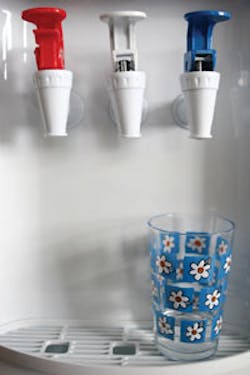
Water coolers continue to be a big growth opportunity for OCS operators as more consumers are concerned about water quality. Point-of-use (POU) systems continue to erode the 5-gallon water market as improved technology raises quality while offering a lower price and more convenience. OCS operators marketing water coolers need to be educated on POU technology like tank sanitation and capacity, while at the same time considering customer needs such as ease of use and aesthetics.
Positioned as informed water professionals, OCS operators should be able to differentiate their service and quality. Consumer water coolers have crossed over into the office market and operators should be able to explain how their products differ in reliability and quality.
Quality among professionals
Tom Ridenour, vice-president, Pine Mountain Springs, Wilmington, Del., explained that years ago there was a change in the equipment market for water coolers. There used to be three high quality manufacturers in the U.S., but then a plethora of imported cheap models flooded in. Now some of those are disappearing and the quality is going back up to where it’s supposed to be, although the brands are still imported.
Chris Sletten, president of Gold Star Coffee Service, Madison Wis., had a problem with the POU quality. The cold water capacity wasn’t sufficient and the flat assembly was unreliable.
He switched suppliers a year ago, and since then he hasn’t had the problems.
Bob Fiddler, vice president of services and vending, Coffee Distributing Corp. (CDC), Garden City Park, N.Y., said it takes trial and error to really compare brands in both POU and 5-gallon systems. He likes to ask manufacturers to send him a demo model. He can then evaluate the quality. This is a main point in considering water coolers, possibly more so than the price, since the price of a water system is recouped by the rental fee charged to the location. He uses a local supplier he knows is reliable.
Across the board, manufacturers make pretty close to the same operating systems, explained Fiddler. But the difference comes in filters for POU and sturdiness of the frame for coolers. “I’ve seen some cheaper ones that are so flimsy I’d be afraid to put a 5-gallon bottle on it,” said Fiddler.
Darrel Leeper, CEO, Cascade Bottled Water and Coffee Service, Farmington, N.M., uses 5-gallon systems instead of POU and points out there is a great difference in quality from a manufacturer making commercial water coolers and what’s available at box stores like Home Depot. The models at retail stores are throw-away coolers with no replacement parts available. The commercial brands are rebuildable, and Leeper tries to stay with a few major brands to limit the stock of parts.
The only thing not worth rebuilding in a commercial unit is the compressor, since it costs almost as much as a new unit itself. Leeper does admit that coolers these days aren’t as reliable as they used to be. Manufacturers are making cheaper units to compete with brands from the retail stores.
Still, overall, the water coolers don’t need a lot of maintenance, Leeper said. His most common maintenance issue is the thermostats needing to be fixed. A good commercial grade cooler will last 15 years, explained Leeper, versus a retail store brand which is closer to two or three. “We want our water coolers to be long lasting, with limited service calls,” said Leeper, “We sell water, not coolers.”
Leeper has a suggestion for 5-gallon water coolers. He’s using a water guard or leak guard. The water jugs themselves have a special cap. The bottle is placed on the cooler without removing this cap and a probe inside the machine pierces the cap allowing the water to flow. The water in the bottle therefore never touches anything but the inside of the machine, avoiding contamination by human hands, dust on the bottles, etc.
Leeper has also noticed less leakage with the caps when the polycarbonate bottles get stress cracks or pin holes in them. Leeper goes as far as to say that the water guard has cut his carpet cleaning bills 95 percent because it minimizes these leaks.
Point-of-use points the way
“People insist on bottled (water) because they think they are getting something better,” said Dan Owens, president, Abesco Inc., which provides beverage dispensing equipment and coffee equipment re-manufacturing services, based in Hoffman Estates, Ill.
Owens also said that the location’s demand of water should be considered. A small POU system can serve a small location with occasional use, not a place with high demand. The recovery time of the system needs to be considered on POU systems. However, even with that drawback, POU units are becoming the mainstream system used in the water service business.
Randy Parks, president, Prostar Services Inc., Carrollton, Texas, uses mainly POU. What 5-gallon business he has he’s phasing out due to the route expense. The big consideration with POU is the filtration. He has a separate division called Guardian Water just for the filtration water business.
There are three levels of water filtration. In-line filtration is the least expensive option and does the highest volume of water, but it has the least performance. Reverse Osmosis (RO) is a step up. Distillation is the best.
The water flowing into the location is the biggest factor when choosing a filtration system. If it’s municipal water that customers say tastes bad, a common GAC (granulated activated carbon) in-line filter will do the trick. But if it’s well water or some poor quality water source, a more involved system is needed.
Parks offers these consumers RO, where the water gets pushed through a membrane with tight pores which can remove TDS (total dissolvable solids) to increase the water quality. It’s still about providing clean, quality water to the customer. “You can now get bottled water quality from a POU system,” said Parks.
Chris Goade, director of Stanguard division, Standard Coffee Service Inc., based in New Orleans, La., prefers to purchase filters from filter manufacturers instead of the brands the cooler manufacturers offer. He finds the filter makers are more knowledgeable and give better service for these products. He also offers a proprietary filter. His customers can either use a carbon system filter or his Stanguard filtration system, a core filtration system that outputs higher quality water.
Overall, Goade finds POU systems very reliable, but stresses the importance of changing the filters. Stanguard has its own filter monitoring system which alerts Goade’s staff when a filter has reached the end of its life. In-field maintenance is also important, said Goade. He sanitizes and cleans the coolers on a regular schedule in addition to changing the filters.
Getting germ-free POU tanks
Sanitation in the water tank is a growing concern among operators as technology advances.
“One of the highest rated consumer concerns is bacteria in water (disinfectant in tanks), said Goade. He uses ozone, a natural bacteria killer, in his tanks. “We feel it delivers a higher quality and more consistent method at a reasonable cost to our customers.” He charges customers an added cost for the add-on ozone system which disinfects the cooler nightly.
Parks offers his customers either ultraviolet light or ozone options to kill the bacteria in the tanks. According to Parks, this does add an additional maintenance cost as the UV lights burn out, although it’s not a big service need.
Ridenour’s customers aren’t prepared to pay the extra cost for in-tank sanitation yet, but he considers offering them a plus. “There will come a time we’ll need it, and I want to know I can get it,” he said.
Dependent on the location
Ridenour sells both 5-gallon and POU units, but sees the market moving to POU. He believes that’s happening because of cost and convenience. Two examples are when the location has a smaller budget and can’t afford water.
“We sell bottled water that’s much purer than out of POU. I used to think it was always the best (for locations). Now I know it’s not what’s best that matters, but what’s best for the customers,” Ridenour said.
POU is a more efficient option for many locations. Additionally, POU is more convenient for an office of predominantly women, who can’t or don’t want to lift 50 pounds of water.
Aesthetics matter
At most locations, aesthetics are important, although not at an additional cost. Most consumers preferred a sleek black or stainless steel unit to the old white or almond models. “The water cooler is the face of the product,” said Goade who sees customers choosing charcoal, black or platinum units.
Goade chooses a cooler style to fit into the environment. He is focused on the aesthetics of the entire break area. “We’re looking not just at coolers; we’re also working in designing break stations and cabinetry to incorporate our coffee brewers with coolers.” The idea is to create a space in the break area where Goade can merchandise all his products with an integrated presentation, including allied OCS products.
Goade is also brand conscious. When 5-gallon jugs were the norm, Goade recalled there were brands on the jugs. The logo represented quality and was important to the consumer, said Goade. Now there are no logos, but Goade is working to still make that quality connection with the integrated displays and merchandising tools he has to communicate the value of the product he’s delivering.
Past the glitter of CD players or radios in the stands, water coolers are pretty much the same inside, said Leeper, with little change to the cooler components. There was a thermo exchange model which cooled water without a compressor, but it didn’t work very well. If two people got 12 ounces of water each, the reservoir tank was empty and served room temperature water, he said.
Other things to consider
Owens doesn’t feel the look of the water cooler is all that important. His major concern is that there is no drain. Customers often mistake the drip tray under the faucet as a real drain and pour water into it or let the water run into it. For him, 99 out of 100 service calls for leaks are because clients are not emptying the tray and it begins to overflow. The machine looks like it’s leaking internally when in fact it is due to the overflow from the drip tray.
Owens would like to see an autofill technology on the equipment, like some fast food restaurants now have. A cup is placed underneath and the system starts dispensing liquid. There is a sensor that measures when the liquid gets near the lip of the cup and stops the flow. It works with any size and eliminates the overflow.
Andy Kartiganer, who operates Professional Vending Services in Coconut Beach, Fla., switched from a water cooler with a stationary bottle to a straight water cooler. He originally wanted the stationary bottle because he perceived customer interest in a bottle system.
He found that if the 5-gallon coolers were in direct sun light, the bottle would turn green. Even if the systems were not in sunlight, the gaskets often leaked and had to be replaced, requiring extra parts and labor. He switched to a POU system and has found there is no less customer demand for a cooler with no bottle and has far less service costs. They simply change the filter every six months.