OCS Sales Rise 5 Points as Quality Drives Growth
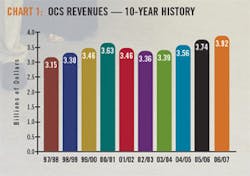
The OCS “turnaround,” heralded in 2004, continues. Coffee service operators are making headway in their efforts to cash in on coffee’s new popularity. For the fourth consecutive year, OCS operators raised aggregate revenue, pushing total sales to $3.925, an all-time high, according to the Automatic Merchandiser Coffee Service Market Report.
OCS operators are boosting sales in a stagnant customer base by providing better quality coffee and charging accordingly.
While the OCS industry continues to lag behind its retail competitors in the vibrant coffee market, OCS operators are gaining ground as they invest in more single-cup brewers and sell more higher pack weight coffee.
The 5 percentage point increase in the last 12-month period doesn’t match the overall retail industry’s gain in coffee sales. Foodservice coffee experienced a compounded annual growth rate of 15.2 percent over the past five years, driven by strong growth in the coffee shop, quick service restaurant and convenience store segments, according to the market research firm, Datamonitor. Convenience stores were the fastest growing single channel.
However, the OCS industry’s recent gain is comparatively stronger than in the previous two years. OCS operators are building sales by generating more revenue from their existing accounts.
The majority of OCS operators increased their prices for the third consecutive year in 2006/2007, as indicated in chart 4. The last three years marked a significant increase compared to the previous five years, when on average, only a quarter of the operators raised prices.
OCS operators have been more confident about raising prices for several reasons. One is the retail pricing environment.
The retail environment changes
In the fall of 2006, Starbucks raised its retail prices for the first time in two years, prompting similar moves by all the major consumer coffee companies, making it easier for OCS operators to raise prices.
The public’s rising appreciation for better quality coffee also played a role. The consuming public has become more interested in better quality coffee, thanks in large measure to the efforts of specialty coffee shops.
This year, the National Coffee Association reported for the first time that daily coffee consumption among adults surpassed that of soft drinks, according to its Coffee Drinking Trends 2007 market research. This national telephone survey revealed that 57 percent of American adults drink coffee daily, compared to 51 percent that consume soft drinks each day.
Consumption by adults tied last year’s record of 82 percent, which had risen from 80 percent in 2005 and 79 percent in 2004. Weekly consumption came in just under the 2006 record high, 67 percent versus 68 percent, but remained ahead of 2005’s 64 percent.
All of the increase in daily consumption occurred in regular coffee, for which daily consumption increased to 48 percent from 47 percent last year.
Daily consumption of “gourmet” coffee beverages softened to 14 percent from 2006’s 16 percent, with subsets espresso-based beverages off by one percentage point from last year to 6 percent, and “gourmet” coffee down to 8 percent from 10 percent in 2006.
While these numbers suggest trending toward increased traditional coffee consumption, how consumers define “gourmet” – given the wider variety of coffee options available in the marketplace – may impact the responses behind the numbers.
Coffee consumption among 18- to 24-year olds jumped 6 percentage points, the fourth consecutive annual increase. Consumption among this age group rose from 16 percent in 2004 to 37 percent in 2007.
The economy strengthens
The state of the economy was also fortuitous for OCS operators in the last two years, particularly the comparative health of professional and service accounts. Much of the nation’s economic growth has been in technology, finance, health care, and professional services; industries that rely on OCS more than manufacturing, which has continued to suffer.
Operators serving markets with high concentrations of financial, high tech, health care and professional employers, such as the West Coast, East Coast and South Florida, witnessed particularly strong growth in the last two 12-month periods.
And while competition from other retail channels has increased, the end result has been a more educated consumer willing to pay for a good quality product in all settings, including the office.
Retail competitors push harder
The intensive marketing by coffee retailers – particularly specialty stores, quick-serve restaurants and convenience stores – impacted office managers in a way that benefited the OCS industry, according to many operators.
Where location managers historically were inclined to reduce expenditures on employee perks in order to save costs, in the last two years they recognized the need to counteract the tendency of employees to leave the work place for a cup of good coffee. According to the National Coffee Association, the percentage of consumers drinking coffee in the office dropped from 64 percent in 2003 to 52 percent in 2006.
The OCS operator, armed with a comparably high quality coffee, emerged as the solution for office managers seeking to keep employees in the office instead of going out for coffee.
The key tool in the OCS industry’s arsenal to provide good quality coffee has been the single-cup brewer, which has been the driving force of the OCS industry’s growth in recent years. Several single-cup systems have proven their reliability, giving the operator the means to offer coffee house quality coffee.
Single-cup provides a solution
Besides providing good quality coffee, the single-cup systems have emerged as the most efficient tool for serving a variety of hot beverages, meeting the demand for different drinks introduced by the specialty coffee shops.
Besides regular and decaffeinated coffee, today’s consumer also wants milk-based drinks, mocha, hot chocolate and teas.
Most OCS operators reported that single-cup systems increased revenues over traditional batch-brew systems by 20 to 30 percent.
Each year, the OCS industry does a better job of meeting the needs of a more educated coffee consumer.
New market research offers consumer insights
The need to do a better job of meeting customer expectations was documented in 2005 when the National Automatic Merchandising Association (NAMA) released some groundbreaking research on how consumers view OCS coffee. The survey, the most comprehensive OCS consumer survey ever conducted, found that consumers overall did not view office coffee as being especially good.
Three quarters of consumers, according to the survey, did not believe OCS operators provided specialty beverages. About 70 percent ranked OCS coffee as average in quality. These findings represented both a challenge and an opportunity.
By providing single-cup brewing systems that provide high quality coffee, OCS operators have been able to demonstrate that office coffee can be comparable in quality to what they can buy at a specialty store.
More investment required to meet consumer needs
In order to provide the better quality service, OCS operators have had to invest more money in equipment, product and employees. The single-cup brewers are more expensive than traditional batch brewers and most of them also require more maintenance. In addition, selling these systems requires a better educated sales person, and servicing them demands a more qualified delivery/service person.
Meeting these challenges has required a high level of commitment, particularly in the areas of recruitment, training and employee compensation.
OCS operators have needed better trained employees at a time when the labor market has not been favorable. Unemployment has remained below 5 percent for the last 12 months, the lowest rates since the end of 2001. (In May of 2007, the U.S. Commerce Department reported the creation of 8 million new jobs since August of 2003.)
While low unemployment helps the OCS industry by raising head counts in work sites, it also drives up OCS wages. Operators continued to fight higher costs in payroll as well as other areas, including health care, taxes, fuel, products, recruiting and training.
Rising costs and a competitive marketplace gave operators no choice but to position themselves as coffee professionals, enabling them to cover their costs with higher priced products and equipment.
About the survey
The State of the Coffee Service Industry Report is based on the results of a questionnaire e-mailed to 600 dedicated OCS operators and 2,700 vending operators with OCS operations. The survey generated a 10-percent response. The commentary in this report is also based on telephone interviews with operators, product suppliers, equipment manufacturers, and researchers.
The aggregate OCS revenue reported in this study includes the OCS revenue reported in the State of the Vending Industry Report, which is published in August. The OCS revenue reported in the vending report includes OCS sold to accounts that are primarily vending accounts. The vending report does not include OCS business handled by dedicated OCS organizations within vending companies, or in partnership with a vending company.
Cartridge systems dominate single-cup
Single-cup brewers continued to increase in 2006/2007, posting an even bigger percentage point gain in unit placements (43.5 percent) than in the prior year (41.5 percent), as indicated in chart 10.
Cartridge-based single-cup systems dominated the growth in single-cup units for the sixth consecutive year. These units are more compact than the hopper-based systems, and require a lower initial investment.
In 2006, some of the key manufacturers of cartridge-based systems introduced lower cost models, making them more economically feasible for smaller locations. They also expanded product offerings, allowing them to meet more customer tastes.
The main factors fueling the growth of these systems are their quality, user-friendliness, product variety, and proven reliability. These units deliver consistent quality control.
Another factor is the commitment the key manufacturers of these systems have provided through field sales and technical support.
Maintaining control of cartridge sales proved problematic for some OCS operators, since the Internet made it possible for unauthorized providers to sell discounted cartridges. It forced some operators to monitor sales and demand that customers honor purchase agreements.
One way some operators were able to enforce purchase agreements was to charge a machine lease fee if the account did not purchase a minimum amount of cartridges.
The manual pod single-cup systems introduced in 2004, designed to offer the same benefits of cartridge-based systems at a lower cost, have not proven successful, mainly on account of poor reliability.
The manual pod system manufacturer that sold the most units also makes pods, thereby emulating the proprietary cartridge model except for the fact that the machine will accommodate other roasters’ pods.
Homeowner models: no impact
The introduction of homeowner single-cup brewers in the last two years did not affect the OCS industry in any measurable way. Some OCS operators sold brewers and cartridges to customers for their own personal use.
The homeowner market witnessed the same dual reaction to cartridge-based and manual pod systems as the OCS market, with consumers, as commercial users, opting for the latter. Cartridge-based systems (sold mainly in high-end department stores and specialty stores) increased 50 percent while manual pod systems (sold mainly in mass merchants and supermarkets) declined 50 percent, according to Homeworld Business, a retail trade publication.
All single-cup formats grow
While cartridge-based systems have dominated the growth in single-cup activity, the more established hopper based systems also posted growth in 2006/2007. The bean grinding capability of some of these units proved a strong selling tool. Some units feature more than one bean hopper for different types of coffee.
Water soluble and liquid concentrate single-cup systems also continued to gain placements in 2006/2007.
Some operators found it more economical to provide a water-soluble, single-cup system next to a traditional batch brewer than introducing a more expensive fresh-ground single-cup system.
Liquid concentrate systems proved useful in catering situations, where speed of service is a big concern. Brewer manufacturers introduced more liquid-based systems for foodservice applications in recent years, some of which found their way into OCS locations.
While single-cup continues to “steal the show,” traditional glass bowl systems posted their first increase in several years in 2006/2007. This came totally at the expense of gravity-fed, airpot and thermal brewers, as indicated in chart 9.
OCS operators have long noted that the decision to use a thermal/airpot or glass pot brewer is oftentimes a matter of personal preference.
Airpot and thermal systems offer the benefit of being able to keep coffee warm for a longer time without burning the coffee, thus reducing waste.
However, some customers enjoy the sensation of seeing coffee brew into a glass pot. Some also find the glass pots easier to clean than metal or plastic thermal containers.
Brand marketing still lacking
The survey once again found that the majority of operators do not have brewers that promote a specific coffee brand, as indicated in chart 8. This is because most operators want the flexibility to switch coffees in the same brewer.
However, the growth of single-cup systems that require a proprietary cartridge could give more operators an opportunity to promote the coffee brand on the brewer.
OCS operators underutilize opportunities to promote brands at the point of sale in comparison to retail channels. Quick-serve restaurants, convenience stores and specialty stores all use in-store marketing tools to promote coffee brands.
Product mix holds steady
The overall product mix did not change significantly in 2006/2007, as indicated in chart 7. From 2001 to 2005, the survey reported a decline in private label as a percent of total sales. This was attributed to the increase in recent years of cartridge-based single-cup brewers, most of which do not use private label coffee, and an increase in the availability of specialty retail brands.
In 2006/2007, private label coffee posted a slight comeback. This can be attributed to price increases by national brands; OCS operators usually have more leverage buying private label coffee.
Private label coffee is not only more profitable; it also allows an OCS operator to provide a proprietary product, thereby strengthening his customer relationship.
“Other coffee” sales, which include whole bean coffee, flavored coffee, liquid-based coffee and varietals, also gained in the last 2-year period. This, too, can be attributed to the gain in single-cup systems which offer more product variety.
Coffee remains the mainstay of the OCS business, but it has declined as a percent of total sales, due partly to the increased variety available in single-cup systems. The non-coffee segment that posted the greatest gain was “other hot beverages,” which include teas, hot chocolate and chais. The gain in these products can be traced to the growth in single-cup systems.
Teas have posted gains in all retail segments, largely on account of their association as a healthy product. Health and nutrition issues have become increasingly important to refreshment service providers.
Allied products also increased as a percentage of sales in the last 12-month period, largely on account of price increases. Many of the allied segments – creamers, paper goods, Styrofoam and plastic products – posted bigger per-unit cost gains than coffee did, resulting in a bigger share of total sales.
Cause driven coffee evolves
OCS operators have also begun to recognize rising consumer interest in coffee-related environmental and social issues. This translates into a growing interest in products that benefit the physical and social environments.
While the demand for environmentally and socially beneficial products isn’t strong, operators found that offering these products can win extra sales.
Environmentally beneficial products include recyclable packaging materials. As local governments have mandated waste recycling, more businesses are interested in purchasing recyclable products, even if they cost more. Several operators noted that recyclable filter papers, packaging materials and other products have become popular with customers.
Cause-driven coffees also fit into this category. Organizations such as the Rainforest Alliance focus on conservation and ecologically-friendly farming, in addition to fair working conditions. More and more coffee roasters have introduced products that are certified by these organizations.
Overall consumption of cause-related coffees have increased significantly in recent years. While most OCS operators have not reported this to be a big seller, those that went out of their way to offer these products found there is a market for them. Roasters have added more cause-related OCS coffees in recent years.
Some OCS operators believe that being knowledgeable about such products enhances their professionalism.
Future promises more growth
Single-cup continues to drive the OCS industry’s sales. Given the fact that only a minority of locations are served by single-cup systems, it’s a good bet that these units will continue to grow in the next few years.
In order for operators to gain the full benefit of state-of-the-art brewing systems, they need to continue to invest in training and in salaries. OCS operators are learning they need to invest aggressively to provide the best quality service to a consumer that is better educated than ever about coffee.
The OCS industry, launched as a work site convenience in the 1960s, has grown into a specialized service. OCS operators have to improve their professionalism to compete against other retail channels that continue to increase coffee sales.