For Better Hiring, Consider Professional Pre-screening
A common hiring blunder was publicly exposed when George O'Leary, newly hired 2001 Notre Dame football coach, was found to have falsified his academic and athletic background. Notre Dame had not checked his information before offering him the job.
There's a lot of pressure to fill an empty position, especially in a small company. Inevitably, people are handling an increased workload and are ready to hand over the job to someone new. Not to mention that candidates walk through the door with their best qualities held out in front of them.
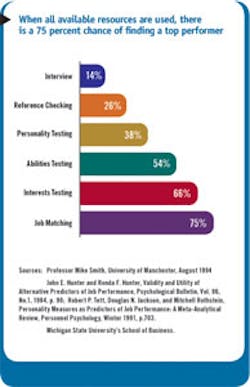
Most companies rely on resumes and interviews to find top performers – the best person for the job. But, according to the Michigan State University's School of Business, using these methods only produces a quality employee 14 percent of the time. Not only are those poor odds, but the cost of this “bad hire” comes out in lost wages/benefits (paying the employee for not doing the job) as well as any lost revenue (lost clients, theft, etc.) associated with the poor hire. Add in the drop in productivity that results when the position again becomes vacant.
In an audio conference by the business journal Kiplinger and employee assessment company Select International Inc., it was estimated a bad hires cost a company $26,035 (based on a salaried employee of $35,000).
CEOs recognize hiring problems
A national survey of CEOs done by Management Action Programs, a business leadership training and consulting services company, in June of 2007 revealed almost a third of surveyed CEOs (32 percent) report up to 50 percent of their new hires weren't meeting expectations over the past two years. And because of this, a whopping 36 percent of CEOs lack confidence in their company's hiring system. The survey did not cover the style of hiring being used.
Among the ways to increase effective hiring is using a pre-screening system, an objective examination of applicants, usually with questionnaire-type assessments and background checks before an interview or other selection process. Successful pre-screening systems can increase the likelihood of hiring a top performer to between 38 and 75 percent.
Prescreening for the vending industry
This past spring, the National Automatic Merchandising Association (NAMA) established a business partner relationship with Profiles International™, an employment evaluation and human resource management assessment company. The driving force behind the relationship was Dave McCaffrey, president of Predictive Assets™, as well as a vending and OCS veteran (starting with Oscar Mayer in 1973 and moving closer to vending through General Foods, Kraft Foods and Starbucks until retiring in 1999).
Predictive Assets™, a strategic partner of Profiles International™, presents hiring assessment tools to potential clients. McCaffrey recognized the Profiles International™ tools would be a perfect fit with NAMA's member companies due to the online functionality, pre-hire to executive development portfolio, and low cost. “These (Predictive Assets) tools can change companies,” he said.
Interviewing versus Pre-screening
While interviewing is the most traditional hiring method, it remains a largely ineffective tool for identifying quality applicants. Kiplinger categorizes four topics a good interview can establish in a candidate: oral communications, competitive drive, leadership style and working with others.
An interview misses work ethic (the no. 1 quality of a top performer), decision making style, empowerment capabilities, resource management ability, written communication skills, and ability to interpret or understand information. Add to this the fact, claimed McCaffrey, that 60 percent of all hiring decisions are made in the first 4.3 minutes of an interview. The rest of the interview simply serves to justify why the interviewer is hiring the candidate or, if not hiring them, going through the motions. It is no wonder the process is ineffective, said McCaffrey. Interviews are like icebergs; only a small percentage of the individual is visible.
Using a pre-screening system can reveal the rest of the iceberg. Using Web-based or even written evaluations of possible employees increases an operator's hiring advantage.
To pre-screen an applicant before an interview, there are two main types of assessments: “screen out” and “screen in.” Predictive Assets has two screen out tests, one that does an employee background check, including driving records, criminal history and resume data. The other is an assessment of employee integrity, substance abuse, reliability and work ethic.
These tools identify the people operators really don't want, said McCaffrey. Then operators can move to screen in tools, where the assessment shows how applicants score against traits the employer wants. At Predicative Assets, this screen-in tool is the ProfileXT Assessment, a powerful and dynamic management tool. McCaffrey said, “it's like getting an operating manual for a new hire.”
The ProfileXT analyzes if a person can do the job (learning/abilities skills), how they will do the job (behavioral traits) and if they will do it (occupational interest). Knowing how a prospective employee ranks is a large part of determining future performance and finding the best person for the job.
“With screen in tools,” said McCaffrey, “the employer has got all the necessary information before the applicant ever comes in for an interview.” If an employer relies solely on an application, resume and interview, this same information only becomes visible after months of employment (which possibly means wasted salary, or worse, an untouchable non-performing employee).
Bottom line: cost
According to McCaffrey, most people agree pre-screening sounds great, but an obstacle remains – cost. How much will this advanced hiring tool cost me? Up front, it's more expensive than the straight application/resume sifting and interviewing process, but for operators who can look a little further down the road, it offers some significant monetary savings.
The vending operation's costs include an initial Website set-up fee and reasonable annual maintenance fee. NAMA members will enjoy a significant discount to the list price set-up fee.
Once the company specific Website is up, it costs nothing for applicants to fill out the application and assessments. The operator can see the applications and answers to the first 10 questions for free. If the operator deems a candidate worthwhile, a click of a button instantly presents the screen-out report (for a fee). If the applicant still looks good, another click reveals the rest of this person and how well they fit the predefined job criteria. That report is more expensive than the screen-out report. Both reports are on an a la carte basis to provide operators with flexibility.
A Canadian vending operator, Kim Locke, McMurray Coin, Fort McMurray, Alberta, Canada, recently became a client of Profiles International™. McMurray Coin is currently using the ProfilesEasy program, a job application system that processes an unlimited number of job applications for a fixed cost per month.
Locke advertises his job positions online, and when a candidate clicks on the link, it leads them to the electronic job application (which includes up to 10 job specific questions). They have the option of attaching their resume (which was Locke's old way of weeding out the candidates) and then to do two assessment questionnaires (the screen-out and screen-in assessments) prior to submitting the job application.
According to McCaffrey, a fully loaded program for an operator that utilizes all available Profiles International™ tools would cost less annually than half of 1 percent of a current employee's annual salary. For an employee making $40,000 per year, this translates to less than $200 per employee. McCaffrey pointed out that considering normal salary increases are between 2 to 4 percent, this is a small price to pay to ensure good hires.
Locke, the Canadian operator using Profiles International™ hiring tools, shared with McCaffrey that he receives fewer applications than he did resumes, but that's all right with him. The applications he does get are much more qualified and he finds value in not sifting through a mountain of resumes anymore, while still finding quality employees.
Tools for current employees and managers
Beyond hiring, Profiles International™ offers other HR tools, all Internet based, to help employers assess and improve their incumbent work forces:
Profiles Team Analysis™ assesses the team balance, defining 12 strengths and weaknesses for each team member.
Profiles Workforce Analysis™ can find out if employees are engaged and enjoy the experience at the company. This survey includes job satisfaction questions, perspectives of the work environment, insight into employees' opinions about human resource issues, the role work plays in their lives, what their needs and preferences are on-the-job, and what motivates them at work.
Profiles International™ CheckPoint 360°™, a dynamic tool that uses a manager's boss, peers and people he or she supervises to gather detailed feedback about the manager, is a competency feedback system measuring job performance in eight skill clusters and 18 universal competencies. As a companion to the Checkpoint 360º, Predictive Assets offers the Profiles CheckPoint SkillBuilder™, a self-improvement program.
Before an interview, an employer needs to get a clearer picture of who's walking through the door. Pre-screening systems allow operators to purge candidates and assist in effective interviewing via the Web with objective assessment methods. Since hiring the right employee is so important, it's a process well worth investigating.