Cashless is Coming; Some Tips on How to Get Started
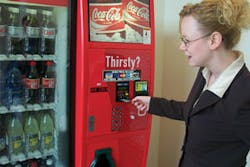
Will cashless vending increase the bottom line, or is it just an added expense?
The answer to this question is that it will increase the bottom line in more ways than you might think. It is helping operators and bottlers right now in several ways including:
• Raising prices without the typical decrease in unit sales.
• Introducing higher priced items.
• Reducing vandalism costs.
• Providing a higher level of accountability.
Our customers, the people who buy from our machines every day, are quickly changing the way they purchase goods and services. Gone are the days when virtually everything was paid for by cash or by check. Now, many people do not even carry cash.
For example, the total amount of goods and services purchased with credit or debit cards in the U.S. in 2000 was $1.552 trillion. In 2005, the number rose to $2.651 trillion (a 70 percent increase) and it is expected to grow to $4.7 trillion (another 77 percent increase) by 2010. The majority of the projected increases are predicted to be in the small ticket purchases (under $5.00).
Here is a good question. Between credit and debit cards, which one has the higher number of transactions? Would you believe that debit cards have passed credit cards by 1.46 billion transactions? Fifty two percent of all cashless transactions are done with a debit card, according to the September 2006 Nilson report, a consumer credit trade journal.
Why the increase in card transactions?
The increasing amounts of credit and debit card transactions are due to a number of factors. First is the increased number of points of sale with credit and debit card capabilities. For example, virtually every gas pump has a card reader. Can you think of the last time you saw a gas pump without a card reader?\
Could vending follow the same path? Fast food restaurants such as McDonald's and Burger King have installed credit and debit card readers at the counters, and guess what? The amount of sales per transaction has gone up! Taxis, toll booths, parking meters, sports stadium concession stands, trains and subways now all provide credit and debit card payment options.
Second is convenience. The card companies are introducing new technology to make the purchase process easier to use for the consumer. MasterCard is introducing their new contactless “PayPass” program which includes a chip on the credit card along with the magnetic stripe.
Rather than giving your card to the sales clerk to swipe the card, the customer can place the card up to the new “tap and go” reader which quickly receives the card information from the chip. The new contactless feature allows the clerk at the fast food restaurant, for instance, to spend time retrieving the order rather than processing the transaction.
The amount of time per transaction decreases, the amount of transactions increases and the restaurant makes more money with a more satisfied customer.
The chips are currently available on credit and debit cards as well as on key chain fobs. In the very near future, the chips will be included on cellular phones in this country. This capability will allow the customer to simply place their cell phone rather than the card to the reader, charge their credit or debit card, and complete the transaction. Credit card companies no longer require a signature for purchases under $25, and the Federal Reserve has ruled that purchases under $15 no longer require printed receipts for these transactions.
The younger generation prefers cards to cash
Third, the younger generation is used to using credit and debit cards to a point where they do not carry cash. And believe it or not, the vending industry had a part in developing this situation.
“Generation P” or “Generation Plastic” is the 18- to 25-year-old age group. And yes, our industry had an influence in creating this cashless generation. Closed card systems have been found on vending machines at college campuses for many years.
Believe it or not, the amount of all products and services paid with a debit card in this age group exceeds the amount paid for with cash and checks. “Generation P,” according to a survey by Visa, purchases 44 percent of their products with a debit card, 16 percent with a credit card, 37 percent with cash and 3 percent with checks.
This group is used to paying for everything, including a $1.25 soda, with a card. Sixty three percent never leave home without a payment card and 60 percent rarely carry cash. They primarily use the card because of the convenience, ease, speed and expense tracking the card provides to them. As the younger demographic tends to be our industry's best customer, it should motivate us to offer the form of payment that our best customers desire.
Wireless data transmission is coming
One of the stumbling blocks that has prevented the vending industry from accepting credit and debit card transactions has been the fact that we have had to physically connect each machine to a phone line in the past. This process was not only cumbersome for the operator and for the customer, but it was costly as well.
With the advent of wireless connectivity, each machine can now be connected to a central server and operating within a matter of minutes. Yes, certain rural areas or certain buildings are not capable of receiving or sending cellular signals, but as the cell phone networks have grown, so has the geographic coverage. When a “no signal” situation does occur, an alternative plan is to connect the machine to the client's Ethernet system.
Look at financial benefits compared to costs
One of the mistakes that operators make when looking at credit and debit card solutions is that they look solely at cost and do not look at the benefits side of the equation.
The fact that credit/debit card transactions are transmitted wirelessly allows these systems to also transmit MDB transactional data such as cash sales, credit sales and column sales. The capability exists to allow the vending operator to retrieve the amount of cash sales via wireless from the machine before the driver arrives at your facility at the end of the day.
Believe me, if the driver knows that you absolutely know how much money should be in the money bag, your losses will go down. An operator once told me, “One of my goals is to keep my honest employees honest.” From a financial point of view, determine your current shortages. How much more money could you send to the bottom line with this simple control procedure?
Reduce Vandalism
Another benefit is reduced vandalism. At least once a week, VendingMarketWatch.com reports an incident of vandalism somewhere in the country. One of the more prevalent locations for vandalism is the hotel site. The thieves are so sophisticated in their methods of breaking into a vending machine that they can accomplish the task in a matter of seconds.
Some operators have solved the problem by totally eliminating the dollar bill acceptor and coin mechanism from the machine and going strictly with a credit and debit card method of payment. They have saved not only the money in the machine, but have also eliminated the damage costs. Many times, the physical cost of repairing the machine in parts and labor is more than the cash itself.
Increase prices in the machine
Another benefit is the ability to have higher prices in the machine.
Energy drinks, organic products, high-end teas and coffees have been huge sellers in the retail market selling for over $3.00. Convenience stores sell fresh food items at a very good markup.
Why hasn't the vending industry been able to capitalize on these results from retail?
Part of it is the purchasing method. We have tried to utilize the dollar coin as a method of paying for products as well as a method for giving change for higher denominations such as a $5.00 bill. Unfortunately, through no fault of our industry, the dollar coin has not gained wide usage by the general population.
Consider utilizing a credit/debit card purchase option to offer these higher-end items to your customers. You may even want to consider a specialty machine to sell higher end beverage products exclusively.
How many of us are still vending our 20-ounce beverages at the same price as two years ago when it should be higher to meet increased costs from the manufacturer? Selling your account on the benefits of a credit/debit card purchasing option will allow you to raise the price of your products and, if done correctly, the account will be more than willing to pick up part of the cost of the card system.
Determine which accounts are profitable for cashless
Determining which accounts are profitable for a credit/debit card vending program can be done by simple testing and a look at the demographics of the account. As I mentioned earlier, the younger generation is a proven user of credit/debit card purchasing options. Locations where a younger population exists would be college campuses, entertainment venues such as amusement parks, and
movie theaters.
Transportation and hospitality locations such as airports, train stations and hotels have been successful due to the fact that customers who use these services are stronger users of payment cards.
Corporate offices with a younger, higher than average income could be potentially profitable locations. Finally, health care facilities such as hospitals have also been proven as decent accounts for credit/debit card programs based on the percentage of card transactions versus overall sales. You will find that the percentage of card transactions to total sales will range from 15 percent to 50 percent with an average of around 20 percent.
The sales call: Questions to ask your customer
Begin your sales call by asking these questions:
1) What type of products would you like to see in the machines that are currently not in the machines?
2) Have you ever wanted to buy something from the machines but were unable to because you did not have the correct bills or change?
3) How do you purchase everyday items? Cash? Check? Debit card? Credit card?
4) Do you feel that most people buy the same way you do?
5) How do you feel a cashless option on your machines might be of benefit to your employees?
Some of the answers you might get include:
1) I would like to see healthier, higher quality items in the machines.
2) With cashless, my employees would not have to worry about having the right amount of change. Any time a machine does not work properly, it is usually because the machine does not take the money.
Let the customer sell themselves on the concept.
At this point, bring up the fact that even though most convenience stores are selling 20-ounce beverages for X-price plus tax, that due to increases in cost from our supplier we need to raise our prices to only Y-price, including tax.
Bring in samples of new high-end beverage products hitting the market. “We would also like to offer additional higher-end food and beverage offerings including salads, entrees and teas. To make it easy for your employees to purchase our products, we would like to introduce a cashless option on your machines.”
Talk about the fast food restaurants and the convenience stores' experience with cashless that we talked about earlier in the article. These are things your client can relate to through their every day experiences. Point out the fact that the use of debit cards has gone up 70 percent since the year 2000 and that it is expected to go up another 77 percent by the year 2010.
Explain to your customer that a cost is involved to implement such a program and that we would like to share the costs. “Fortunately, the increase in the soft drink prices will allow you to maintain the same commission dollars you are currently receiving and at the same time provide this convenience to your employees.”
Subtract part of the cost of the cashless system from their commission. The other benefit for you, the operator, is that unlike normal price increases where unit sales go down, with a cashless option, your unit sales should go down less if not stay the same. This allows for additional revenue. Unit sales will go up at locations where pricing remains the same. This will help to offset the costs for a cashless system in no commission situations where prices are at proper levels.
In summary, cashless vending, if implemented properly, can be a useful tool to increase the bottom line. Use it as part of your marketing strategy to keep current business, obtain new business and grow your sales by offering new products and convenience for your customers.
About the Author
Scott Larkin is a sales director at USA Technologies Inc. He has also worked in vending operations management and sales, managing software and equipment manufacturing, and distribution. He can be reached at [email protected].