OCS Drives Full-Line Vendor's Growth
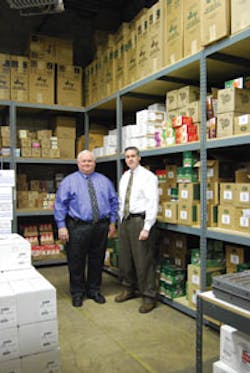
While the workforce, and therefore the customer base, at vending locations shrinks, those operators who offer OCS have the opportunity to expand. In fact, coffee has been quite lucrative for Commercial Coffee Service/Food Systems Inc., Bridgeview, Ill., producing 35 percent growth in the last two years, compared to a relatively small increase in vending business.
Co-owner Tom O’Malley attributes most of the OCS success to finding and winning new accounts in the southern Chicago market. “We’re knocking on doors,” he said, although some of the OCS business is based on adding the service to previous vending-only locations.
O’Malley and partner Lee Hartnett both started at the company as 18-year-olds, running routes under the original owner, Ray Ornder.
“In 1979, I moved on to become a shop mechanic, then a street mechanic, then into other areas of operations,” said Hartnett. O’Malley took over Hartnett’s routes until he was promoted to sales.
Almost 20 years later, Ornder was ready to retire. Hartnett and O’Malley were already running most of the day-to-day business, so Ornder offered them the opportunity to buy the company instead of selling it to a competitor.
Long time friends, the pair jumped at the chance and bought the company and the building. Hartnett took over the operations side, equipment and personnel while O’Malley continued in sales, logging hours to find new business. After 30 years, the partners remain passionate about vending. “We still enjoy coming into work,” said O’Malley.
“We look forward to coming regardless of the economy,” added Hartnett. “We just like doing it.”
Since buying the company, O’Malley and Hartnett have focused on aggressive growth and replacing or upgrading equipment. The business grew 30 percent in the first two years under the duo, despite the effect of 9/11, and the OCS business has more than doubled.
TAILOR OCS TO THE LOCATION
O’Malley uses his years of experience to determine a coffee proposal for a location, whether it’s an airpot with basic coffee, cream and sugar, or a single-cup, multi-flavor specialty brewer. “I see what they’re doing currently, then come back a second time with a program and some coffees to taste test,” said O’Malley. He likes to choose about 10 people to be the focus group. They meet before lunch to taste two or three coffees (out of the 40 brands Commercial Food Systems carries). He also includes refreshments to complement the coffees. Usually the decision is made right there if Commercial Coffee Service gets the OCS business.
In the last three years, O’Malley has had tremendous success with the Keurig single-cup machine and Green Mountain Roasters coffee. Among work places with a majority of 18- to 30-year-olds, specialty brewers, teas, liquid creamers and better grades of coffee are doing very well. “Some of these breakrooms look like coffee shops,” said O’Malley. This age group drinks more coffee than the same group did 10 years ago. The single-cup brewers allow locations to bring their employees back from the coffee houses.
Another program Commercial Food Systems instituted for OCS customers is free giveaways. When a customer orders a certain number of boxes of coffee, Commercial Coffee Service will put in a free tin of pre-made cookies or powered drink mix. “It was to encourage volume purchases,” said O’Malley. “For locations that order one or two boxes at a time, now they will order three or five boxes to get the free cookie tin.” The free giveaway is always changing to keep the idea fresh. The company announces the giveaway in its quarterly newsletter to its customers. The newsletter also has trivia contests where clients can win gift cards as well as read about company news.
Personal customer service is important to O’Malley and Hartnett. Coffee is delivered by a dedicated OCS driver to 98 percent of their accounts instead of using a delivery service such as UPS. This is possible because of Commercial Coffee Service’s relatively small servicing radius, no more than 60 minutes in each direction. If a company requests service outside the servicing radius, O’Malley and Hartnett will run numbers to determine if it is feasible. If not, they recommend them to a friendly competitor with whom they don’t directly compete. “We’ll recommend them to an operator whose service radius doesn’t really overlap ours,” said Hartnett. “A vendor we’ve built a relationship with in BVA (Better Vendors of America) or IAMC (Illinois Automatic Merchandising Council).”
Another way Commercial Coffee Service communicates with its OCS customers is by putting out table tents in the breakrooms when a coffee machine has been serviced and cleaned. Previously, accounts wondered if the equipment was being cleaned, since this was referenced in the proposal and they didn’t see it done. The table tents reassure customers the machines are clean and Commercial Coffee Service is concerned about the service they provide.
The growth in OCS has been completely organic.
“We never bought a competitor,” said O’Malley. Instead, the company has lots of referrals and visits many potential customers. “As for myself, I love going out and doing the coffee demonstrations,” said O’Malley.
FULL-LINE VENDING PROVES TO BE AN ASSET
Many OCS customers also ask Commercial Coffee Service to provide other items, such as soda or water, when they find out it’s a full-line vending operator. It’s not unheard of for OCS and vending locations to request Commercial Coffee Service/Food Systems to put the machines on free-play or provide different coffees to boost morale.
Although the gains have not been as significant as OCS, vending remains a viable part of the business. In the last few years, the company has heavily used gold dollar coins, and added $1 and $5 changers to machines. Any spare money Hartnett can find goes into upgrading product delivery systems, changing cold food machines to spiral, experimenting with LED kits and new equipment.
“Recently, we bought the Crane’s new Merchant Six that accepts $10 and $20 to recycle $5’s back to the customers,” said Hartnett. This is a direction Commercial Food Systems intends to pursue rather than cashless readers.
One move O’Malley and Hartnett have made is to buy almost all their own beverage machines instead of using bottlers’ equipment. “I’d say 95 percent of the equipment out there are our machines,” said Hartnett. The advantage is that Commercial Food Systems can have a Coke product and a Pepsi product next to each other. “If we don’t do that, competition will,” added Hartnett.
Commercial Food Systems also reconditions its own equipment. Hartnett not only uses paint to give the machines a face lift, but also Tuffronts’ covers. “I love them (Tuffronts),” said Hartnett, “I use them on almost everything.”
Product reconfiguration is ongoing for Commercial Food Systems. While they maintain quarterly planograms for 80 percent of the machine, Hartnett regularly tries new products in the wild card spirals. “I like to bring in different products with different price points,” said Hartnett. An interesting consumer reaction he’s noticed is that once the price point breaks a $1, such as $1.25, the $1 price point looks much lower by comparison.
With price being a big issue for consumers, Commercial Food Systems recently implemented “value vending.” For customers who base their decisions on cost, rather than healthfulness or brand, there’s a single shelf in a glassfront machine that carries less expensive products like Diet Rite or RC Cola.
Although this is a new program, Commercial Food Systems ran a similar program for its 45th anniversary. For the entire year, the prices for one or two items were 45 cents or less. The company had point-of-sale clings made for the machines and spiral stickers denoting the anniversary-priced items. “Each month, these items flew off the shelves,” said Hartnett.
Hartnett and O’Malley negotiated aggressively with product providers for these items. Anticipating a higher volume, they were able to negotiate for a reduced price or additional products. After the 45 cents for 45 years promotion ended, a lot of customers talked about it. Commercial Food Systems plans to do it again, perhaps for its 50th anniversary, for 50 cents an item.
O’Malley and Hartnett know price isn’t the only concern for locations. Schools, for example, want healthy options. O’Malley and Hartnett came up with a different planogram for schools. After a rough start determining a profitable number of healthy products in a machine, they successfully implemented a plan with two types of machines. One has healthy options and is serviced once a week, while the other carries traditional selections, which is serviced once a day.
BENEFITS KEEP LONG TIME STAFFERS
One thing the owners say contributes to Commercial Food Systems’ success is its low worker turnover. Many of the employees have worked at Commercial Food Systems as long as O’Malley and Hartnett themselves. The head service technician has been there 32 years.
“I think (the low turnover rate) does say something about the environment,” said O’Malley. “Once someone starts a career with us, they stay and grow as well.” Besides the obvious enthusiasm of the owners, which infects the working environment, O’Malley and Hartnett offer employees full benefits. The company provides medical insurance, 401-K matching, health savings accounts, and fair wages.
Perhaps the days of operators running a strictly OCS business are gone. Locations want both services and comparatively priced one-stop-shops like Commercial Coffee Service/Food Systems are winning their loyalty with quality customer service. The continued increase of OCS business indicates it’s a strong service to offer when trying to grow revenue.
Profile: Commercial Coffee Service/ Food Systems, Inc.
Headquarters Location: Bridgeview, Ill.
Bought By Current Owners: 1998
Owners: Tom O’Malley and Liam “Lee” Harnett
Number of Routes: 9 routes (7 vending, 2 OCS)
Number of Employees: 20
Software Supplier: MEI
Annual Sales: Not revealed
GREENER VEHICLES YIELD SAVINGS
Besides new vending equipment, Lee Hartnett, co-owner of Commercial Coffee Service/Food Systems Inc., is investing in new vehicles. He recently bought an ASTG body repair van to replace his Ford and found he got 50 percent better gas mileage. “It’s saving us $250 a month for just that vehicle,” said Hartnett.
?
RAISING PRICES — COMPARATIVE PRICING FORM HELPS WIN SUPPORT
Commercial Food Systems takes a strategic approach to raising prices. Tom O’Malley, co-owner, goes to comparable retail outlets (c-stores, grocery stores and even Wal-Mart) and buys the product he plans to raise the price on in his vending machines. He then copies the receipts on Commercial Food Systems’ letterhead and brings it with him to the customer location. This allows the customer to see how his price compares to other retailers. “I believe each location has the right to that personal conversation (about price increases),” said O’Malley. The comparative price letter indicates the new price is fair and is still a good value. O’Malley sympathizes with the route drivers, however. “We educate them so they can give an educated answer, then say ‘just hold on tight and don’t take it personally.’” Commercial Food Systems also places a form letter on the machine explaining the increase to employees at the location.
SEPARATE SERVICE SYSTEMS SUPPORT OCS AND VENDING OPERATIONS
Commercial Coffee Service/Food Systems maintains two separate service programs via computer, one for OCS and one for its full-line vending division.
The OCS program tracks required filter changes and cleaning, as well as maintenance needed.
Both programs include: problem called in, time, person who called, contact phone number, the time the problem was dispatched to the service tech, time fixed, service done, and time the person who reported the problem is called to be made aware of the solution. According to the owners, customers really like this extra last step. It’s another way Commercial Coffee Service/Food Systems excels at customer service. Individuals monitoring the service calls communicate with service technicians via Sprint phones. The owners found shopping around got them a better deal on a communication system.
?
?
About the Author

Emily Refermat
Emily Refermat began covering the vending industry in 2006 and served as editor of Automatic Merchandiser from 2012 to 2019. To reach the current editor of Automatic Merchandiser and VendingMarketWatch.com, email [email protected].