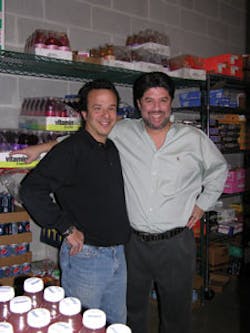
Highland, Ill.-based S&O Vending proves vending persists as a viable business opportunity for creative entrepreneurs. Co-owner Jeff Shapiro, being an experienced high-end restaurant manager, has a unique view of how to run a vending business. As the director of operations for Carmichael’s Chicago Steak House in Chicago, he uses personal service, new equipment and products tailored to account demographics to wow the customer. With the help of his current partner, Steve Kritz, S&O Vending is growing into a serious player in the highly competitive Chicago market.
PART-TIME START UP
S&O Vending began on a whim. Shapiro was working in the restaurant business when he decided he wanted to own and operate a vending business. He saw vending as a great second job opportunity that would provide additional income and be fun to do. “I didn’t see one or read an article or anything, it was just an idea I had,” he said.
Shapiro started the business in 2004, with a partner, Richard Oleff, who sold his half of the business to the current partner, Steve Kritz, in 2007, when the commitment became excessive for the returns.
S&O’s first machine was a soda vender at a friend’s facility. Shapiro bought the machine with his credit card. Jim Carbone, then a manager at a local equipment distributor, sold Shapiro the machine, but didn’t take him seriously. Most people didn’t just start a vending company; they bought a machine with accounts or bought an established operation. Shapiro’s business thrived, however, and Carbone, who has since gotten into the operating side of the business himself, became a key knowledge source for Shapiro.
Oleff shared the day-to-day responsibilities with Shapiro, working around his public relations/advertising job to cover appointments while Shapiro was at the restaurant.
Shapiro serviced the routes in the beginning, using his pickup truck to deliver product to locations a few hours before work. “I was very driven. I didn’t want any empty coils, especially if I had more of the product just sitting in my garage or warehouse,” said Shapiro. “I made changes every few days.”
Shapiro grew up in the Chicago area and used his friendships to gain clients. “People would rather do business with people they have a relationship with rather than someone they don’t know,” said Shapiro.
From the accounts he gained, Shapiro realized that many existing vending banks weren’t giving customers what they wanted. The equipment was often old or damaged. The customers didn’t always want the products that were in the machines and there were often empty spirals.
Shapiro saw an opportunity to set himself apart by giving the customer a better quality vending service. He installed new machines and kept them stocked. He encouraged customers to call if a spiral was sold out. And
he focused on unusual products.
FOODSERVICE BACKGROUND OFFERS A BENEFIT
“My foodservice ties opened the door to products not available to the vending channel,” said Shapiro. A few years ago, he found single-serve hummus with pita chips in small bags. It was not available in vending yet. He put it in white collar accounts and watched it sell.
He was vending individually wrapped pickles and tuna kits before other vending operators, giving him a reputation for having unique products.
Shapiro continues to attend food shows for the high-end restaurant he manages, and it opens his eyes to innovative products he can bring to his vending machines.
While Shapiro and Kritz use vending supply houses, they are currently buying two-thirds of their top products from foodservice supply houses.
AN ‘ACCOUNT-CENTRIC’ APPROACH
Because S&O has a mix of different vending accounts including municipalities, car dealerships, schools, offices and factories, it tailors its product offerings to the account.
The process begins with assessing what was already offered by the previous vendor. Shapiro or Kritz visit the account two or three times before taking it over to see what people buy or what they are saying. They may ask the location manager about the sales volume or send out an email blast or questionnaire for product requests.
When S&O took over an account with a majority of Hispanic workers, they assigned a driver who could speak Spanish. He came back with requests for brands more familiar to the Hispanic workers, such as Marinela and Bimbo. It was difficult to find some of the requested products, but Shapiro and Kritz used foodservice purveyors to help them meet the challenge. After putting in Hispanic pastries and cookies, sales at the account nearly quadrupled.
If a location is white collar, S&O looks at perceived healthy options, like granola and energy bars. S&O tries to get the brands this group would see at specialty retail stores, such as Trader Joe’s.
SCHOOLS SEEK NUTRITIOUS SNACKS
School requests for nutritious snacks have increased, according to Shapiro. Hence, S&O works with nutritionists to find healthy alternative foods such as fruit smoothies, fresh fruit and other seasonal perishables, as well as the baked chips.
“It means carrying a wider product variety, but we believe it’s a necessity,” said Kritz. One example of how carrying specialty products benefits S&O is a high school requiring kosher products.
When approached by the account, Shapiro and Kritz investigated the availability of kosher products and found there were more available than they expected. For instance, many Snyder’s of Hanover products are kosher.
“Since we’re already doing one, it opens doors for us to pick up similar environments, especially if we are doing it well,” noted Shapiro.
Not all specialty requests are available. And not all that are available will sell. Hence, S&O relies on drivers as the eyes and ears of the company at locations to indicate which items aren’t working and which should be tried. Route drivers are given freedom to select some products themselves.
A newly-installed remote monitoring system is making it easier to determine profitable product selections.
RESTAURANT GIVES THEM BUYING CLOUT
Because Shapiro manages a large restaurant, he is able to negotiate better prices for some products in his vending operation.
Shapiro and Kritz also make use of manufacturer supplied promotional items. S&O places stickers on bottles and snacks that customers can use to claim branded hats, mugs, or other promotional items.
While neither Shapiro nor Kritz has ever measured whether these promotions increase sales, they know it raises morale. “It’s giving back to the everyday guy,” said Shapiro.
GROWTH REQUIRES MORE SPACE
From the beginning, Shapiro has tried to run S&O Vending as professionally as he runs his restaurant. He started renting storage space for vending products less than a year after starting S&O, and has outgrown the space three times since 2004.
Shapiro and Krtiz currently rent a 1,000-square-foot warehouse with a large dock door for deliveries. They own three vehicles and employ three drivers, one of whom also repairs machines.
“My ideas possibly hurt me at the beginning (financially), but if we want to sell the company or grow larger, the proper business management systems are in place,” said Shapiro. He uses QuickBooks for payroll and accounting.
Running the business professionally includes treating the vending customer with integrity, said Kritz. Coming on board in 2007 from a retail electronics’ business, Kritz brought experience in managing routes and dealing with consumers.
Communication between management and the location is vitally important to running a professional business, so S&O makes sure price increases are communicated with care. First, the decision maker is contacted, and then a notice is put on the machines to inform consumers. “We’re not afraid to charge what we need to,” said Kritz, “and the customer deserves to know that.”
TECHNOLOGY BRINGS NEW BENEFITS
Shapiro and Kritz recently became interested in a remote monitoring system they saw at a trade show. They put 25 Cantaloupe Seed systems in their busiest machines. While it worked well for the route drivers, Shapiro and Krtiz soon realized having all the Cantaloupe systems on one route would be better than having them spread out.
“When we put it on one route, it told us how to run that route most efficiently. It changed how we do business completely,” said Shapiro. The system has already paid for itself through improved efficiency and operations.
Kritz said the system is like having a location manager on every machine. It reports what’s selling and when it sold. It has allowed S&O to prekit the route.
“We tell our customers about it, and they think it’s a great way to do business,” said Shapiro. Locations like to know S&O has a pulse on what’s selling. When one account asked for three months’ worth of sales reports, the Cantaloupe system really helped. “It gives a snapshot of what people are buying,” said Shapiro.
OCS: NO SET PROGRAM
S&O added OCS when Shapiro noticed people would spend more on a cup of coffee than on chips. About 20 to 30 percent of S&O’s vending accounts also include OCS.
Shapiro installed the machines and water lines himself in the beginning, calling on coffee industry sources for help with installation as well as what product and equipment to buy. Currently, S&O’s coffee service offerings range from basic OCS at car dealerships to single-cup machines at business and industry accounts.
Since most accounts already had OCS from a previous provider, Shapiro and Kritz match the service they previously had or go a step above it.
They were pitching a LavAzza machine to a white collar account which only had drip coffee and decided to hold a tasting. They took a LavAzza representative to the location with a machine. An email was sent to the location employees announcing the free coffee.
“We spent five or six hours as their ‘coffee shop,’” said Shapiro. After the tasting, he asked the location if they wanted to keep the machine or if he should remove it. The location asked him to leave the machine.
Shapiro and Krtiz are seeing more bulk coffee sales, as price is becoming more of a concern. The company has not expanded into private label.
REMAINING PART-TIME OWNERS
Shapiro and Kritz have no plans of quitting their regular jobs while building S&O Vending. They spend much of their free time at the warehouse. Kritz works in the morning before going to his retail job and Shapiro works nights after getting off from his shift at the restaurant.
“It’s a sacrifice, but it’s a worthwhile one,” said Shapiro.
‘Green’ products create new growth opportunities
Something S&O Vending is really excited about is new ‘green’ disposable cutlery. The forks, spoons and even plates are made from potato and corn byproducts and are 100 percent biodegradable. “The reality today is that these products are more expensive, so we’re offering them for those early adopters — companies with people passionate about the environment,” said partner Steve Kritz. S&O has also bought mugs for each employee at some locations, instead of offering disposable cups.
Profile: S&O Vending
Headquarters Location: Highland Park, Ill.
Founded: 2004
Owner: Jeff Shapiro and Steve Kritz
Number of Routes: 3
Number of Employees: 5
Main Equipment Lines: U-Select-It, Crane Merchandising Systems, Progema, LavAzza, Brio
Software Provider: Cantaloupe Systems
Annual Sales: Not revealed
About the Author

Emily Refermat
Emily Refermat began covering the vending industry in 2006 and served as editor of Automatic Merchandiser from 2012 to 2019. To reach the current editor of Automatic Merchandiser and VendingMarketWatch.com, email [email protected].