Recession Tests Management Skills
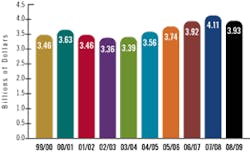
The party is on hold, but it’s by no means over. A recession has shaken the U.S. economy and tripped the OCS industry’s 4-year growth curve, but operators and suppliers remain hopeful growth will return. In May, some economists claimed there were signs of recovery.
OCS operators have not responded to the economic downturn in a reckless manner. Like many of their customers, OCS operators have adjusted their service schedules, reviewed their operating expenses and reduced overhead to protect profitability.
In 2008/2009, OCS sales posted a 5 percentage point decline from the prior 12-month period, marking the first setback since 2003/2004. OCS revenues totaled $3.9 billion in 2008/2009, according to the 2009 Automatic Merchandiser State of the Coffee Service Industry Report.
The 4-year gain from 2003/2004 to 2007/2008 was the longest consistent growth trend in the industry’s history, driven by higher pricing and investment in better quality products and equipment. The percent of operators raising coffee prices declined in 2008/2009, but most operators still raised prices, continuing a trend that began in 2004/2005, as shown in chart 3A.
The use of single-cup brewers, which have played a big role in the industry’s growth in recent years, remained high at 18 percent of all brewers in 2008/2009, slightly less than the all-time high of 19 percent the prior year.
OCS sales have fallen as a direct result of declining worksite populations and employer cost cutting. The nation’s unemployment hit 9.4 percent in June of 2009, the highest level since 1982. Location managers have mandated across-the-board cutbacks in operating expenses, including OCS.
In addition to reducing staff, many employers cut hours for remaining employees, further reducing the need for OCS.
FINANCIAL SECTOR TAKES A HIT
Layoffs in the financial services sector were particularly devastating to OCS since these employers are better than average OCS customers. Challenger, Grey & Christmas Inc., an outplacement consultancy, reported that financial sector job cuts jumped from 153,105 in 2007 to 260,110 in 2008, after nearly tripling in 2007 from the prior year.
The most common scenario OCS operators faced in the last 12 months was having customers tell them they need to cut OCS expenses by anywhere from 10 to 20 percent. Such a scenario presented a challenge, but not a disaster, since it allowed the operator to still service the account profitably.
Operators claimed that employers still want to provide good quality coffee, reflecting the overall consumer appreciation for coffee that OCS operators themselves helped to build in recent years.
In such situations, operators offered less expensive coffees and/or reduced ancillary products. These actions were evident in the survey results.
The percent of private label coffee sold rose to its highest level in more than five years, shown on chart 5, indicating OCS operators are using private label to offer a good quality coffee at a reduced cost. Private label has always been a tool for operators to provide better quality coffee at less cost than national brands.
OPERATORS HELP CUSTOMERS REDUCE COSTS
An Automatic Merchandiser reader survey in March found that switching to a less expensive coffee was the most common way to help customers reduce OCS costs. Close to 40 percent of operators took this approach, followed by 24.8 percent who reduced non-coffee products, 16.8 percent who found other methods, 8 percent who added payment mechanisms, 6.6 percent who lowered coffee prices, and 5.1 percent who lowered prices for non-coffee products.
The 3.58-point gain in private label came at the expense of national brand coffee in 2008/2009. National brand coffee posted a decline in all but one of the last five years.
When national brand posted a 2-point gain in the previous 12-month period, some observers noted the impact of national coffee house brands. The coffee house brands introduced in recent years offer a higher selling price than the more traditional national brands.
OCS operators have found coffee house brands a good sales tool since it allows them to offer popular products and also capitalize on retail advertising.
OCS operators have also used coffee house brands as a tool to market less expensive private label coffee. By offering a private label coffee similar in quality to a coffee house brand, the operator can provide coffee house quality coffee at a lower cost.
Renewed customer interest in cost management made OCS operators more cognizant of the need to maintain good customer relations in the past 12-month period. Customer relations has always been a key point of difference in OCS. Customer service gives OCS a point of distinction against retail coffee outlets.
Operators have always pointed to customer service as a value that customers cannot get from a retail channel that doesn’t offer it.
This point of difference — customer service — proved critical in the recession as more competing outlets — membership warehouse clubs and office supply retailers — offered more coffee products.
DECISION MAKERS FOCUS MORE ON COSTS
Operators noted the recession did bring some new factors to consider when selling their service to customers. Decision makers were more focused on cost. Hence, it was necessary for operators to communicate the full value of their service, as well as offer lower cost options.
The recession did affect the premium that many customers have historically placed on employee satisfaction. Many operators noted that higher unemployment made some employers feel it was less important to provide employee perks. Operators understood this customer sentiment since they themselves, as employers, experienced the same thing in their own operations: employees were more concerned about their job security and therefore demonstrated more commitment to their employers.
Operators had to remind account decision makers that OCS directly impacts employee productivity. They also needed to point out that OCS provides a tangible benefit and is less expensive than other employee benefits.
Single-cup brewers, the OCS industry’s key tool for meeting the demand for coffee house quality in a convenient manner in the workplace, continued to gain placements in 2008/2009, despite the recession.
Operators in large urban markets where single-cup has been well established reported less growth in single-cup placements than did rural markets. Equipment manufacturers reported placing more machines in rural markets where single-cup is less established.
In some cases where locations downsized, operators removed single-cup machines and replaced them with batch brewers.
Most operators claimed they were able to maintain single-cup machines in spite of downsizing. This demonstrates the value that customers place on single-cup. Single-cup brewers generally deliver a better quality coffee and are easier for employees to use.
Airpot and thermal carafe systems also gained at the expense of traditional pourover and automatic batch brew systems, as indicated in chart 6.
CARTRIDGE SYSTEMS CONTINUE TO LEAD SINGLE-CUP
The cartridge-based single-cup systems continued to lead the growth in single-cup. Cartridge-based systems are more compact than hopper-based systems and require less initial investment. They also offer considerably more product variety.
While cartridge-based systems require less initial investment, the cost on a per-cup basis is higher than for a hopper-based system. Some operators noted that with customers looking for ways to reduce expenditures, the hopper-based systems offered a solution. The hopper system allows an operator to continue providing high quality coffee to the account at a lower cost to the account.
However, the leading cartridge systems have gained strong brand equity in recent years, which has made operators reluctant to switch to other systems.
HOMEOWNER SINGLE-CUP SYSTEMS CONCERN OPERATORS
The expansion of some of the cartridge systems into the consumer market has concerned some operators. Single-cup consumer units, which are mostly cartridge systems, rose from $66 million in 2004 to $225 million in 2008, and are the only growth segment of the homeowner coffeemaker market, according to Homeworld Business, a magazine which tracks homeowner appliances.
On one hand, the growth of the consumer single-cup market has supported the demand for these systems in the office.
On the other hand, this growth has raised concerns about consumers pilfering cartridges in the office as well as concerns about customers buying their office coffee from other sources.
Veteran operators note that such concerns are not new in OCS. Customer location managers have always had to make sure employees don’t steal coffee, and operators have always had to make sure customers don’t buy product elsewhere.
MOST OPERATORS RAISE PRICES
While customers wanted to cut costs, operators still protected their margins, as indicated in the number that raised prices.
Fewer operators raised prices and more lowered them in the last 12-month period than in any of the previous four years as shown in chart 3B, but 66 percent still raised prices.
While OCS pricing was competitive, the retail environment helped OCS operators raise prices. Major retail roasters raised prices early in 2009 in response to higher costs of Colombian coffee.
More than a fifth of the respondents, 22 percent, reported adding payment mechanisms to brewers. This is the first year the survey asked the question, making it impossible to measure any change in the level of this activity.
Most operators indicated a slight increase in the number of customers asking for payment mechanisms in 2008/2009. Operators usually try to discourage this because it cuts consumption, as well as increases service calls and, in cases where the OCS operator services the brewer, requires currency collections and accounting.
In response to these requests, some operators provided the payment mechanism but let the customer collect the money. This frees the operator from dealing with collections and allows the customer to recover some of the cost.
OPERATORS PASS ON FUEL CHARGES
Operators passed on fuel charges for the second straight year in 2008/2009. More operators introduced fuel charges than last year, as indicated in chart 9A: 13 percent more operators charged for deliveries in 2008/2009 than the prior year. This represents a significant cost recovery action, given the decline in fuel costs over the past year.
Operators also charged an additional 76 cents per delivery this year, as indicated in chart 9D.
Price increases were one of several cost recovery actions in 2008/2009. Most OCS operators reported raising prices and absorbing higher costs, as indicated in chart 10.
Staff reductions were fairly common among operators: 45 percent reduced staff while 14.5 percent added staff and 40.5 percent reported no change.
Staff reductions mostly affected delivery personnel, as indicated in chart 11B. This is consistent with the earlier reader survey, which reported less frequent deliveries as the most common action to improve account profitability. Close to half (46.8 percent) of the operators who took action reduced deliveries, compared to 34.3 percent who added products and services, 13.6 percent that took other methods, and 5.3 percent who added brewers.
Among the 14.5 percent who added staff in 2008/2009, most (56 percent) added sales personnel while 44 percent added delivery personnel. Operators recognized the need to maintain good customer communication to protect sales.
EMPLOYEES SHOW MORE COMMITMENT
Like their customers, operators noticed stronger employee commitment as workers valued their jobs more in a recession. In 2008/2009, many operators noticed a reprieve from the perennial problems of high employee turnover.
Operators welcomed improved employee commitment as the demands of OCS have become more challenging in recent years due to the need to become knowledgeable about more products and equipment.
Staffing actions were one area of difference found between dedicated OCS operators and vending operators with OCS operations. (Vending operators who do OCS represent the majority of both the number of operators and amount of sales, but dedicated OCS operators continue to do more OCS business on a per-company basis.)
Dedicated OCS operators sustained staffs more than vending operators with OCS operations, which indicates dedicated OCS companies have a better chance of maintaining and adding sales.
In comparison to the overall respondent base, more dedicated OCS operators added staff (15 percent compared to 14.5 percent) while only 30 percent reduced staff.
Operators offered mixed views on the importance of environmental benefits. Some claim customers are interested in these benefits, while others claim customers are not willing to pay additional costs for them.
OCS OPERATORS ADDRESS ENVIRONMENTAL CONCERNS
Dedicated OCS operators were more active in offering environmental benefits than vending operators with OCS operations in 2008/2009. Sixty percent of dedicated OCS operators added products to address environmental concerns compared to 45 percent of all respondents.
Environment-enhancing products include recycled products (cups, filters, pods and utensils), water filtration devices to reduce single-serve bottled water, and coffee with sustainability features (organic, Fair Trade, or bird friendly).
Sustainability is one of the benefits of the coffee pods that have been on the market for several years. Pod-based systems were introduced as an economic alternative to cartridge-based single-cup systems and also offered sustainable coffee packaging.
Many operators are reconsidering pods as an economic alternative to cartridge and hopper systems. Pods offer the product variety of cartridges and cost less. In addition, an operator can source pods from a variety of roasters, whereas with cartridges, he can’t.
Many operators believe that environmental benefits will become more important when the economy improves and customers become less concerned about costs.
APPRECIATION FOR GOOD COFFEE REMAINS STRONG
Helping operators argue their case for providing good quality coffee is the fact that consumer appreciation for the product remains strong, according to consumer research.
Daily consumption of coffee beverages among consumers remained consistent in 2009 with 54 percent of the overall adult population partaking, according to the National Coffee Association (NCA) 2009 National Coffee Drinking Trends survey. This is statistically on par with the 2008 figure.
Additionally, cups-per-drinker and cups-per-capita continued to hold at the level from 2008 and the previous four years. The NCA reported the number of consumers who drink coffee at work remained consistent at 18 percent, while fewer are partaking in restaurants (5 percent) than in 2008 (8 percent).
If the economy does improve, OCS operators will find a stronger demand for their services, and the positive sales trend of the previous four years will return.
In the meantime, OCS operators must continue to invest in their staffs and their products and equipment. The retail coffee environment has become more competitive than ever, with retail and foodservice operators competing more aggressively for consumer coffee sales.
About the survey
The State of the Coffee Service Industry Report is based on the results of a questionnaire emailed to 600 dedicated OCS operators and 2,700 vending operators with OCS operations.
About the Author

Elliot Maras
Elliot Maras served as the editor of Automatic Merchandiser magazine from 1993 to 2012. To reach the current editor of Automatic Merchandiser and VendingMarketWatch.com, email [email protected].