'Turnkey' Healthy Vending Gains Placements
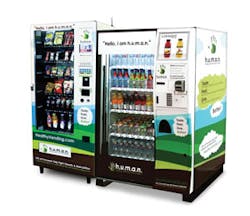
It’s eye catching — a vending machine wrapped in colorful graphics touting words like “healthy,” “natural” and “organic.” It looks like an answer for consumers who ask for better-for-you products.
However, specialty vending programs are nothing new. A few years ago, the Atkins and South Beach no-/low-carbohydrate diets gave birth to all kinds of vending programs offering low- or no-carb products in dedicated machines. Vending industry veteran Bob Grosh started Low Carb Vending LLC, which offered vending operators designated low-carb vending machines and low-carb snacks from a number of manufacturers. He closed the program in 2007 after three years because there wasn’t enough demand. “The media made a bigger deal out of it than it was,” said Grosh.
Pure Foods LLC, an at-home deliverer of diet meals and snacks, discontinued its vending program of combination machines with low-carb products and preferred beverages when the program was no longer in line with the strategic plan of the company, according to a company representative.
LOW-CARB BROADENS TO HEALTHY
But new healthy vending programs continue to emerge as demand for “better for you” products grows, despite the recession. And turnkey programs that offer machines, the products to stock them and locations to place them in continue to bring new people into the vending business.
“It’s the best time to do (healthy vending),” said Jim Kulka, a new operator working with H.U.M.A.N. Healthy Vending, one of the “turnkey” healthy vending programs available. He started Natural Snack Vending in Colorado Springs, Colo. in April 2009 when he decided he wanted to get healthy products to kids in a fun and quick way.
He chose H.U.M.A.N. (helping unite man and nutrition) Healthy Vending because it has a history of offering healthy vending programs to gyms and health clubs, under the name FitFuel, and eventually expanding to colleges.
In 2009, H.U.M.A.N. offered people like Kulka a chance to own their own healthy vending business using H.U.M.A.N.’s name and marketing.
Kulka was impressed with the various sizes and configurations of machines H.U.M.A.N. offered, wrapped in graphics associated with healthy products.
For someone new to the business, Kulka also wanted a company that would find him locations, install the equipment and train him on how to use it for a reasonable fee. The digital LCD screens displaying streaming videos, credit card readers, power-saving devices, touchscreen control panels, and remote-monitoring technology were bonuses. H.U.M.A.N. also provides contacts for product suppliers like United Natural Food Inc., which supplies Whole Food Market, and Europa Sports.
SCHOOLS RESPOND POSITIVELY TO HEALTHY VENDING
Kulka’s gotten outstanding response from school administrators and CFOs. “I take tons of food to wellness meetings with school administrators,” said Kulka. His favorite products include juice-based beverages IZZE and The Switch, as well as popcorn and CLIF bars. The products are often gone before the meeting begins.
Kulka is unconcerned about the higher price points healthy products carry, usually 50 cents to $1 more than traditional products. According to Kulka, the Colorado public school market is a unique environment because soda and “junk” food will not be allowed for new a la carte and vending contracts, so there will be less competition.
His biggest hurdle is older existing contracts and waiting for “requests for proposals” required by school boards. He commenced his “premium location acquisition” phase with H.U.M.A.N. in July 2009, which includes a comprehensive, local marketing campaign that identifies and secures locations in the Colorado Springs area.
TURNKEY PROGRAMS BRING NEW COMPETITION
Turnkey programs sometimes bring unwelcome competition for traditional operators trying to sell “better for you” products. Camelback Vending Services in Phoenix, Ariz., is one such example. Although Camelback uses the National Automatic Merchandising Association (NAMA) Balanced for Life program (now called Fit Pick), the company encountered a machine placed by a turnkey “healthy” vending program that wasn’t abiding by the district’s nutrition rules.
Jodi Glimpse, vice president of business development, Camelback, knows the Arizona rules and does her own evaluation when a new product claims to be school approved. Healthy vending products, she noted, require a lot of research.
“It’s still an 80-20 business,” said Glimpse, “80 percent of your profits come from 20 percent of your products.” She relies heavily on remote monitoring technology to tell her what products are selling and what should be replaced. She also relies on her connections with location managers and keeps up-to-date on legislation that may affect food offerings.
Glimpse contacted the purchasing manager at the school where a “healthy” vending machine was placed next to her equipment without her knowledge, citing her contract with the district. The purchasing manager seemed unconcerned, saying the new machine was simply a test program for the final month of the school year.
THE ‘HEALTHY’ MACHINE MISLED CUSTOMERS
Glimpse said the fact that the machine said “healthy” misled people, including the district staff, into believing the products inside were better for them. She found several products in the “healthy” vending machine that violated state and federal nutrition rules. One example was Hansen’s All Natural Soda, which was being sold in a school where district rules do not allow the sale of any carbonated beverages. “They didn’t even have products to meet state regulations,” said Glimpse.
Glimpse also didn’t think kids would pay the premium price for some of the products. In the machine she saw, organic chocolate milk sold for $2. In her machine, the price for chocolate milk was $1.
Within a month, the machine was removed from the school due to low sales. While her own company’s sales were not affected, the incident did create concern.
MOST HEALTHY - VENDING LOCATIONS: SCHOOLS
Advocates of the turnkey programs nonetheless claim they are meeting a rising need. Mark Trotter, CEO of YoNaturals, claims a lot of school districts are removing traditional vending machines. Companies with healthy vending programs, like his, are, in his words, “scooping up the locations right behind them.”
Since 2006, YoNaturals has been selling the concept of non-traditional and healthier products in vending machines. The program allows people to start a vending company quickly. YoNaturals supplies the machines, finds the locations, continues to market the idea, delivers machines, installs and trains the new operator, and helps them choose products. The machines include cashless payment systems.
The feedback from one operator who recently invested in the YoNaturals turnkey program may sound overly optimistic to some, but after a year, it’s still going well.
“I started my business in 30 days,” said Tom DiPasquale, who started a vending operation in Rochester, N.Y. with YoNautrals in 2008. He fills the machines after his day job. He’s very pleased with his return on investment. DiPasquale’s goal was to get 30 vends a day per school. That would give him a profit and allow him to pay off the machines in three years. Currently, he averages 50 to 60 vends a day, with vends going as high as 125 to 150 a day in three schools during football season.
DiPasquale did some of his own legwork, verifying that the products in the machines met New York guidelines. He said while some of the schools have replaced traditional vending machines with his machines, most offer both. He believes having both machines is positive because it allows kids to have a choice.
While turnkey programs are addressing a rising customer need, one question that remains is the integrity of the operators coming into the industry.
Eddie Hicks, president of Prestiage Services in Clifton Park, N.Y., has seen a number of turnkey programs that resemble “blue sky” opportunities which promise big profits for little work. In these cases, the operators aren’t able to give locations the service promised.
About four years ago, a radio disc jockey in Hicks’ market started an organic vending business. The organic products were popular with schools, and the business grew. Unable to keep up with service, the disc jockey sold it to an established regional vending operator.
“As long as the turnkey healthy vending programs are ‘legit,’ the services they provide can have some merit when tied in to other elements of standard vending,” said Hicks.
Hicks doesn’t use turnkey programs himself since he wants to select his own locations. “We want to make sure it’s adequate for us in the long run,” he said.
Many locations like custom graphics
Though some locations like the graphics of the dedicated healthy vending machines, Hicks believes these graphics work best in places with a lot of public traffic. A more captive audience cares more about what is in the machine.
For products inside the machine, Hicks uses the NAMA Fit Pick program. The program includes a sticker above the coin mech that explains the program to the consumer and a logo on the slot with products that fit the program’s nutritional guidelines.
Some established operators have tried turnkey programs, only to encounter issues with getting the right product at the right time.
ESTABLISHED OPERATORS TRY TURNKEY PROGRAMS
Joel Sax, owner of M&P Vending in Chicago, Ill. tried Stoneyfield Farms vending program in 2005. It was a short-lived program where Stoneyfield gave a machine to a school, then the school contracted an operator to fill it with Stoneyfield products.
“We had trouble getting the products,” said Sax. “And when we did get them in, the wrong product was sent or it would have a bad date.” The products also didn’t sell well.
“It was just like selling a salad in a sandwich machine — very few accounts actually buy them, but everybody says they want them,” said Sax.
He thinks the major hurdle for healthy vending is that customers don’t want to pay a higher price for these products. For his school accounts, he’s using yogurt, pretzels, wheat thins, baked chips and other products available from vending distributors. He’s tried some unconventional products at these accounts, like fruit in a bag, but they didn’t sell well. “It’s a great marketing tool,” said Sax about healthy vending, “but not realistic.” Still, Sax said he can’t ignore the growing popularity of stores like Whole Foods. If that demand translates to vending, he wants to offer the products and services. He’s not sure it will, since different people may shop at Whole Foods than patronize a vending machine.
Sax is interested in turnkey programs because they promise to find locations for him. He feels the investment is minimal and being able to offer vending machines designated as healthy will help him get accounts. He would put some of these machines next to traditional machines. “If at some point it (healthy vending) makes money, I’ll be pleasantly surprised,” he said.
VARIETY HOLDS KEY TO HEALTHY PRODUCTS
“We’re successful because of the type of products we’re putting in,” said Gill Sanchez, a vending industry insider who has worked for two vending operations before starting Vend Natural in 2007.
Vend Natural offers machines with healthy-looking graphics, delivery/installation, training, software reporting, Web-based training, location assistance, and marketing support. The company also puts operators in contact with distributors for specialty products considered healthy.
Sanchez believes lack of product variety is one reason some healthy programs have not succeeded in vending.
He tracks product sales via Cantaloupe software in each machine he sells to operators and makes suggestions based on sales data. Operators also have access to the data.
“Healthy vending to a traditional vendor might be baked chips or a hard granola bar,” said Sanchez, “but we offer products like Pirate’s booty (puffed rice snack) and Naked (smoothie drinks).” Many of the products are readily available in the traditional vending channels, but aren’t offered to customers. Sanchez believes having to carry extra products and charging higher prices is what deters traditional operators. He also believes his machines are intended for a different clientele. “They’re designed for the person who wants an alternative snack,” said Sanchez. He believes the Vend Natural machines would work next to a traditional vender.
SOFTWARE CAN HELP HEALTHY PRODUCT SALES
Paresh Patel, president of Courtesy Vending in Portland, Ore., believes any operator using software and data effectively can do healthy vending themselves.
“Monitoring item level data can help the operator objectively determine how well healthy products are selling relative to the items that were replaced,” said Patel.
He uses the NAMA Fit Pick program to help identify “better for you” products in his machines. Patel got into healthy vending early, becoming involved in drafting the state school food regulations. He joined wellness committees and even stood next to the governor when he signed wellness legislation into law. As a result, Patel enjoys the image of a health-conscious vending operator and receives unsolicited calls from school districts asking for healthy vending.
Most turnkey healthy vending programs attract new operators focused on healthy food and looking for a business to start. Veteran operators, however are skeptical. Some feel it’s worthwhile if the locations and products are found for them. Others think it’s easier to do the research and product selection themselves if they can effectively leverage the data from technology to see big sellers in the healthy food categories.
Turnkey programs may be a trend, but with legislation and nutritionists advocating more change in diets, healthy vending, in some ways, could be here to stay.
For more information, contact
H.U.M.A.N. Healthy Vending: 323-230-5008, healthyvending.com
NAMA Fit Pick: 312-346-0370, www.fitpick.org
Vend Natural: 310-880-8103, vendnatural.com
YoNaturals, Inc: 858-794-9955, yonaturals.com
About the Author

Emily Refermat
Emily Refermat began covering the vending industry in 2006 and served as editor of Automatic Merchandiser from 2012 to 2019. To reach the current editor of Automatic Merchandiser and VendingMarketWatch.com, email [email protected].