Roundtables Mull Profitability, People Issues
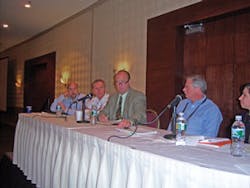
Roundtable sessions addressed numerous topics at this year’s Coffee Summit, and to enable all the attendees to learn from all of them, the National Automatic Merchandising Association used a technique known as “round up” panels, in which seminar leaders reported the highlights of their seminars to the full assemblage. The Coffee Summit was held earlier this summer at the Crowne Plaza in Cherry Hill, N.J.
Much discussion addressed ways to improve profitability during a recession. Several attendees noted the importance of making sure an account has the right equipment for its needs. An account that has downsized may not need the same amount of equipment as it once did.
Other attendees noted that the recession is a good time to add sales people since more customers are shopping the market to get the best deal. One operator said that his company won business when it added sales people during the early 1990s recession. The company grew even more when the recession ended and customers resumed their pre-recession spending habits.
First-day roundtable sessions addressed sustainability and preparing to “go green,” account retention and conversion practices, route structure, profitability, hiring the right route people, and single-serve coffee trends.
WHAT IS ‘SUSTAINABILITY?’
Barbara Pritikin, integrated marketing communications manager at Kraft Foods, noted her company spent a lot of time identifying “sustainability,” which has become an industry buzzword. She said Kraft took a cue from the United Nations and considered the social, environmental and economic impacts of everything the company does. “What we do today affects the future generations,” she noted.
Pritikin noted Kraft and other manufacturers have partnered with TerraCycle™, which “upcycles” products and prevents garbage from ending up in landfills. Kraft has also partnered with Rainforest Alliance™, which certifies coffee that meets rigorous social and environmental standards.
Paul Schindelar, vice president of sales at Kraft’s vending/OCS division, noted that addressing sustainability can help an operator win business. Operators can do this by using bio-diesel fuels, global positioning satellites (to ensure efficient fuel use) and LED lights (to ensure efficient energy use).
Regarding account retention and conversion, Kevin Daw, president of KNJ Sales, asked his listeners how they make clients aware of new equipment and concepts. One answer was making customers aware of upgrades when it comes time to renew the service contract. Another was to attach flyers about new equipment to invoices. Still another was to educate customers about what the OCS operator must do to maintain profitability.
To build profitability, Daw recommended offering products of different levels of quality at different price points.
When manufacturers raise prices, some attendees suggested sending personalized letters to customers while others felt it is important to discuss the matter in person.
Another suggestion was to give a customer an opportunity to “buy in” at a certain price as protection against future price increases.
Still another suggestion was to show cost increases on a per-cup basis. “Always distill your pricing down to the lowest (unit),” Daw said.
On the subject of what to do with used equipment, some suggested placing equipment manufacturers’ logos on used equipment as a way to sustain customer confidence.
Donating used equipment to public agencies can qualify a business for tax deductions.
WHO MAKES A GOOD ROUTE PERSON?
Regarding hiring the right route person, Mike Jones, vice president of john conti Coffee Co., stressed the need to decide who you don’t want to hire. The route person is very critical to OCS success.
Jones suggested paying attention to driver applicants’ email addresses. The email address can often reflect the person’s character.
He warned listeners to stay away from candidates who change jobs frequently.
Jones noted that drivers from other route-based businesses might seem like good candidates, but operators must realize that these drivers might think they already know how to run an OCS route.
Jones said it pays to ask prospective candidates questions on the phone before having them in for an interview. One question to ask upfront is the salary expectation.
An important question for any prospective driver is if they can respond quickly to customer comments and concerns, Jones said. “We need people who think fast on their feet,” he said.
He suggested also asking them about their weaknesses. OCS operators want drivers who are confident, but not too confident.
Before hiring a new driver, Jones said to make sure they ride a route with an existing route. This will give both parties — employee and employer — a chance to see if it’s a good match.
He said it also makes sense to have the person first work in the equipment repair center, giving them some equipment training.
Jones encouraged his listeners to recruit prospective candidates even when the company is fully staffed in order to have someone ready when an opening arises.
He suggested asking waiters and waitresses at restaurants if they’re interested in becoming OCS drivers. “If you don’t have a system, it’s a crapshoot,” he said.
He noted his company has not hired one driver from classified ads.
In summarizing the single-serve brewer session, Steve Silha, Midwest regional sales manager for LaVazza Premium Coffee Corp., noted technology is changing the single-serve brewer market. He said cashless payment is an emerging option.
Sustainability of portion control packs is also becoming an issue, Silha noted.
As for marketing single-cup, Silha said many OCS operators have found social networking Websites to be helpful avenues since the target demographic — young people — frequent these Websites.
E-commerce expert offers tips on how to have a good Website
Consider sensible product categories,
search boxes and customer reviews.
Everyone in business today realizes that having a good Website is important, but knowing how customers and potential customers use your Website can be difficult. To address this concern, Richard Smith, president of OCSAccess, an e-commerce solution specifically designed for OCS, presented a session on
e-commerce during the Coffee Summit.
Most OCS Websites list products the company offers. Smith said it is important to organize the products in a way that is easy for the user. A user should be able to click on a product category listing to call up subcategories within that main category listing. He said it’s possible to have three levels of categories without confusing the user. “Don’t overdo it; there is a point where it will actually add confusion,” he said regarding categorization.
One issue that operators often fail to address is how categories are named. Smith said it is important not to use industry specific terms like “frack pack” since it
will confuse many potential customers. “Just because
it’s intuitive to you doesn’t mean it will be to the shopper,” he said.
He said it’s also important to avoid using abbreviations, even if they are common in the industry.
Smith suggested asking someone who doesn’t know your business to try to find something on your Website.
SEARCH BOXES ARE A MUST
Search boxes are important. “No matter how good your navigation is, you have to have the search box,” Smith said. “Some people will use the search no matter how good the categories are.”
Website software usually allows site managers to track searches, which Smith encourages. These tools allow an operator to track the most searched for items.
The search tool can give an operator good marketing insight. “You can learn things from searches; it’s not just for users,” Smith said. He noted that one office products Website allowed users to search for garbage bags by bag thickness. The company learned that its customers often searched for garbage bags by thickness.
Website search functions should allow a user to find what they want even if they misspell a word, Smith noted. He said there are ways the search can find the item using different spellings.
It is important for Websites to have visual appeal, Smith said. For Websites that market products, product images are important. “They (product images) actually do assist people in finding what they’re looking for,” he said. He said it’s important to have consistent image size and quality.
One consideration is to use images that don’t take too long to download; this will discourage users.
If product pictures are not available to post on the Website, Smith suggested using graphic logos.
In addition to product images, Smith said it helps to have graphic material that makes the site pleasant to view. One suggestion for OCS Websites is to have pictures of happy people in an office setting.
Allowing users to review their experiences on the site can add credibility, Smith said. “If you integrate customer reviews into your Website, people will read them,” he said.
Customer reviews can even present selling points the operator hadn’t thought of. “They may put a whole different spin on it for you and it may be for your benefit,” Smith said.
He said there are review services available for Websites. Two such services are: www.powerreviews.com and www.bazaarvoice.com.