To Win in OCS, Duo Fine Tunes the Basics
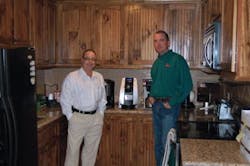
OCS has certainly changed from the time Mike Ferguson and Paul Endres first went to work at Custom Coffee Plan (CCP) in Houston, Texas in the 1980s. Customer needs were much simpler then and the range of products and equipment was less extensive than it is today.
Working for a big operation gave Ferguson and Endres a solid understanding of OCS. So when they got the entrepreneurial itch in 1991 to launch their own operation, all they needed was a reliable delivery vehicle, a work area and some functioning pourover brewers to get started. But they also needed to be committed to delivering a high quality service, and the tools to do this were changing.
When they started Southern Refreshment Services, Ferguson and Endres paid attention to consumer needs, kept abreast of new products, and eventually bought computers and OCS specific software. As a result, they have been able to provide a highly professional operation in an industry that they and many others now recognize as a specialty.
The pair didn’t have a lot of capital when they began their business, but they understood the fundamentals of OCS and they have remained committed to them. Today, their company holds a strong market position as a leading independent OCS player in Greater Houston.
Southern Refreshment Services offers OCS, water service, break room supplies and cleaning products. The company provides a wide assortment of products and it uses the Internet to solicit and educate customers. The company Website allows customers to place orders via email, and to be a selling tool for sales reps.
HUMBLE BEGINNINGS FOR BOTH PARTNERS
Ferguson did not have a clear career direction when he took a job as a coffee salesman 22 years ago. Having worked as a cook, waiter and a bus boy, the 21-year-old Ferguson felt qualified to work in the foodservice industry when he responded to an opening at CCP for a coffee salesman. He thought the position was to sell coffee to restaurants. He had no idea what OCS was.
Endres was already employed at CCP as a service tech. He later took a position as a route driver.
CCP, a division of Farmer Bros., introduced Ferguson and Endres to the OCS business. They both found they had a passion for OCS. The economy was growing at the time, and many businesses wanted OCS.
At first, Ferguson spent most of his time knocking on doors, doing demonstrations, and signing up customers. He eventually moved to a delivery position, where he was able to learn the route and customer sides of the business as well.
SELLING THE BENEFITS OF OCS
Membership warehouse clubs were making their initial forays into OCS at the time. But Ferguson was able to counter the warehouse clubs’ lower prices by showing the customer how many times the product was being handled from the warehouse to the office. The employee had to pull the box from the retail or wholesale warehouse shelf, haul it to the counter, take it to the car, bring it to the office store room, then eventually move it to the break area.
Ferguson made the customer realize that all of this handling affected the product.
The business was much simpler back then. Products and equipment were mostly limited to pourover brewers and fractional packs. Ferguson and Endres reasoned they could go off on their own without too much difficulty. “I knew the sales end; he knew the service end,” Ferguson recalled.
They launched Southern Refreshment Services in 1991 in their garages. They bought used equipment from operators and restored it. They also bought a used van and repainted it. They went knocking on doors offering national brand fractional pack coffee and pourover brewers.
From the very beginning, Ferguson and Endres wore uniforms bearing their company logo.
PRIVATE LABEL BRINGS AN ADVANTAGE
In eight months, Ferguson and Endres signed an agreement with Excelso Coffee Co. to provide private label fractional packs. They remain committed to this day to
Excelso Coffee Co. for the support the roaster gave them in that crucial early period.
Growth was steady. After one year, they moved out of their garages into a rented warehouse.
Ferguson and Endres didn’t realize it right away, but they had picked a good time to be competing against national brands with high quality private label coffee. In the mid 1990s, some national roasters were offering customers lower pack weights which they claimed delivered the same quality coffee as heavier pack weights. Ferguson was able to successfully sell his private label against the lower pack weights. “That (the lower pack weight national brand) really helped us,” he recalled. “It (the private label) went over like hot cakes.”
In two years, they hired their first employee, Endres’ brother-in-law, Fred Sierra, to repair brewers and wash decanters. Sierra is now the general manager. Around this time, they also invested in their first OCS management software system.
EARLY INVESTMENT IN OCS SOFTWARE
They were just learning about computers. Not many small OCS companies invest in management software, but Ferguson and Endres recognized the need for good accounting software in a business that must keep track of equipment, orders and inventory.
In 2000, they hired their first dedicated sales person. This proved to be an important advantage as OCS products and equipment were evolving. Better quality products and equipment — such as airpots, single-cup brewers and specialty coffee — gave the company the chance to distinguish itself from the competition. Ferguson and Endres believe that it is necessary to have dedicated sales people to market these benefits.
Ferguson said he prefers hiring sales people who don’t have OCS experience; too many OCS sales people are not instructed to emphasize quality over price.
The most important background Ferguson looks for in a prospective OCS salesperson is cold calling experience and customer service experience.
EXPANSION INTO VENDING
Ferguson and Endres learned early on that a lot of customers wanted vending in addition to OCS. They first tried partnering with dedicated vending operators to meet these requests. Unfortunately, the vending operators they worked with did not provide a level of quality they wanted.
In 1995, they expanded into vending. They hired a dedicated vending driver so they could offer vending to those customers who asked for it. They bought, moved and serviced their own equipment and built a base of vending customers from their OCS customer base.
The pair never considered mixing vending and OCS products on the same deliveries. “Vending and coffee should be separate,” Ferguson said.
But the company was never as committed to vending as OCS. Even though the vending business grew to five routes in a 10-year period, Ferguson and Endres never felt vending was as profitable as OCS.
VENDING PRESENTS ITS OWN SET OF ISSUES
Vending customers, they found, were less willing to accept price increases than OCS customers. They found it harder to raise vending prices due to competitive pressure.
In 2005, they switched to a more powerful management software package, which confirmed their suspicions: the vending business was not as profitable as the OCS side.
Ferguson and Endres faced a difficult choice: divest the vending business which was 50 percent of total sales to focus more resources on the OCS business. And risk losing business to customers who wanted both OCS and vending. They nevertheless chose to sell the vending routes and focus on OCS. They sold their vending routes to Fresh Brew Group USA, based in Houston.
The divestiture went smoothly, with very little customer loss.
Ferguson and Endres then used the proceeds from the sale to fund their OCS growth and remodel their 14,000-square-foot building. “We love the coffee business; we have a passion for it,” Ferguson said.
The decision to focus on OCS proved fortuitous.
REFOCUSING ON OCS AND INVESTING IN SPECIALTY COFFEE
OCS was becoming more specialized. Specialty coffee retailers were educating consumers about better quality coffee, and single-cup systems and airpot brewers allowed OCS operators to offer better coffee in the office.
Southern Refreshment Services had already become one of the first Keurig distributors in Houston. Keurig offered more product variety that covered more day parts than glass pot brewers. The variety addressed the problem that OCS operators face when trying to get all employees at an account to like one type of coffee.
Single-cup became increasingly popular with customers, and Southern Refreshment Services witnessed strong single-cup growth through 2007. When the recession hit in 2007, customers wanted to reduce their expenditures, but they did not want to discontinue OCS.
Single-cup sales have continued to increase, even in the recession, Ferguson said.
The introduction of homeowner Keurig brewers and K-Cups has not had any adverse impact, Ferguson said. Customers can buy K-Cups over the Internet at a lower price, but if they do this, they risk losing the office Keurig brewer. Most customers do not want to lose this, he noted.
Single-cup coffee now accounts for 20 percent of the company’s coffee sales. Ferguson believes it could become as much as 30 percent.
SOFTWARE AND TECHNOLOGY BRING BENEFITS
The company’s use of management software has been one of its greatest strengths.
The company uses maintenance scheduling and invoicing software. All service calls are recorded and stored for future reference. This ensures that billing, warranties, and preventive maintenance on equipment are documented completely and accurately.
The ability to instantly send techs service tickets and other information directly to Blackberries ensures that the tech performing the repairs has the most up-to-date information possible.
The company also uses a satellite vehicle tracking system to guarantee quick response time.
OCS handhelds have proven to be a great time saver for both the drivers and the customers. “It basically made us paperless,” Ferguson said.
COMPANY WEBSITE PROVES HELPFUL
Ferguson and Endres were also among the first OCS operators to launch an Internet Website in 1995. While the first Website they designed was very simple compared to their present one, it gave them a more professional image.
When Keurig approached them about carrying homeowner Keurig units in 2007, Ferguson and Endres initially resisted since they were reluctant to expand into the homeowner market.
They did, however, recognize the need to have a more professional Website to market their OCS business. They designed a Website that explains all of their products and services.
Customers can leave messages and place orders via email.
The new Website is user friendly, has professional photography and offers in-depth descriptions of OCS brewers, water coolers and water filters.
The company is offering the Colibri single-cup machine for customers who want single-cup coffees along with hot cocoas and cappuccinos.
RECENT EXPANSION: ONLINE SALES
The company recently added a section on the Website to sell coffee machines and other break room equipment for customers that want to buy them online.
The company offers health and retirement benefits for employees.
In retrospect, Ferguson feels that he and Endres have been lucky in some areas: their timing in getting into OCS when the overhead required was comparatively low; the opportunity to sell against low-pack-weight national brands; and the aggressive positioning with single-cup early before that segment’s evolution.
But all of these things were rooted in a commitment to serving the customer; the fundamentals the partners learned on the front line.
Profile: Southern Refreshment Services
Headquarters Location: Tomball, Texas (Houston area)
Founded: 1991
Owners: Mike Ferguson and Paul Endres
Vehicle fleet: 5 16-foot delivery trucks, 2 service vans
Brewer lines: Keurig, Flavia, Colibri, Bunn
Private label roasters: Excelso Coffee, Fresh Brew Group USA
Software supplier: Crane Streamware
Annual sales: Not revealed