Second career success story
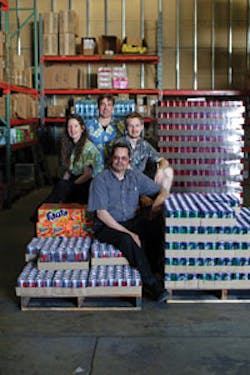
Robert Cornelius readily admits he knew practically nothing about vending when he bought a vending business with 50 customers four and a half years ago. The San Jose, Calif. native was in the middle of a divorce when he decided to leave his previous business and find a new way to make a living.
Had he known at the time how hard the vending business is, he might have looked for something else. He hates to admit that he actually believed the person who told him he only had to work one day for every $10,000 in monthly sales.
Nevertheless, Cornelius has been able to build his company, Custom Touch Vending LLC, into a profitable 2-route operation, having more than tripled the size of the original business.
Cornelius was able to leverage his prior experience as a lifelong car salesman and auto dealership owner/manager. He was also fortunate enough to find a good, seasoned industry veteran to bring him up to speed.
In the four and half years Cornelius has been in the vending business, he has proven that a committed entrepreneur can still make it in vending.
a Foundation in the auto business
Cornelius spent most of his life working in the auto business, following in his father’s and both grandfathers’ footsteps. But in his early forties, he faced some tough circumstances. He was getting a divorce, and the ownership of his business assets was in dispute.
Cornelius decided to find another way to earn a living. He remembered an uncle in Memphis, Tenn. had done very well in vending.
His auto dealership had a vending bank, so Cornelius asked the vending operator servicing the machines how he could get into the vending business.
The operator put him in touch with someone who wanted to sell an operation with 50 stops.
Unfortunately, the guidance he got early on was misleading. “I actually thought the vending business would give me more free time,” Cornelius recalled.
He paid a sum equal to a year’s worth of gross sales for the business, which included a leased 800-square-foot warehouse, one delivery vehicle, the machines, some product inventory, and an employee who handled deliveries, bookkeeping and money counting.
There was a mix of accounts: auto dealers, auto body shops, industrial accounts, high tech companies, and elementary schools. The machines mostly consisted of snack and cold drink machines. Most of the cold beverage machines were leased from bottlers.
A BAPTISM BY FIRE
Cornelius’ first move was to clean the warehouse and try to understand the books. The employee he “inherited” was only going to stay on a temporary basis.
His next move was to meet with all the locations and introduce himself.
Cornelius was confident in his interpersonal skills, but he also knew he had to learn about vending. He called other operators out of the local phone directory to see who would be willing to meet with him. He found the San Jose vending operator community very willing to help a sincere newcomer.
“Everybody I called said ‘yes,’” he said. “I was able to establish some really nice relationships with some other successful vendors in my market place right off the bat.” These relationships proved crucial to his future success.
When he visited other operators, he learned how vending warehouses are organized. He also learned the specific employee roles. “I took pages and pages of notes,” he recalled.
“It was obvious that some of these guys were more successful than others,” he said. He noticed that operators who treated their employees better were more successful.
EARLY PROFITS PROVED ELUSIVE
Cornelius was led to believe the locations would gross $30,000 per month and yield $15,300 in gross profit.
In his first week, his gross profit barely surpassed half the anticipated amount. Most of the accounts produced less than $200 a month.
Things got worse before they got better. The employee was gone after one month, and Cornelius had to run the route himself.
Being the father of five children, he also had responsibilities outside of work.
Assisting him was his girlfriend and business partner, Suzanne Suwanda, who handles the bookkeeping, accounts receivable, accounts payable and money counting.
The business was not bringing in enough profit to support the lifestyle he was used to, so he supplemented his income by selling cars to automobile wholesalers.
He was working a total 80 hours a week to support himself and keep the business afloat.
A FOCUS ON CUSTOMER SERVICE
Cornelius believes his background in car sales was helpful in establishing good relationships with customers. He notes that the auto industry places a lot more emphasis on customer service training than the vending industry. “We (in the auto industry) are constantly training our people and checking their attitudes,” he said.
He gave all his customers his mobile phone number.
“If a customer calls me and says, ‘Hey Robert, we want this item,’ I’ll make a special trip and take it to them,” he said. “I build relationships with the customer.”
He made sure not to raise his prices until he felt that the customer relationship was well established. “I would wait until people were saying to me, ‘We’re glad you’re our vendor now,’” he said.
Running the route himself and selling cars on the side, Cornelius didn’t have time to solicit new accounts. So he made it a point to tell his existing accounts that he was looking for more business.
After three months, he began to get new accounts from existing customer referrals. “They (the customers) helped me,” he said.
Cornelius had some idea what dollar volume he needed for an account to turn a profit. He told his new accounts that if they didn’t reach this figure, he would require a subsidy or also include OCS.
Cornelius learned that many operators are quick to turn away accounts if they have fewer than 30 people. He, on the other hand, tries to find a way to make an account profitable.
IN SEARCH OF QUALIFIED HELP
Cornelius knew he needed someone to help him. One day, he called an employee of one of the national vending operations for advice on how to repair a machine. He realized that this man, Mike Johnson, had a lot of experience in vending operations. Johnson had been a mechanic, driver, warehouse supervisor and route supervisor in his 27 years with the three nationals and a large regional vending operation.
Cornelius offered Johnson a job, but was turned down. Johnson said he didn’t think Cornelius could afford him.
In response, Cornelius offered to match Johnson’s existing compensation and the chance to be a manager and share in future profits. Johnson liked the offer, and became Cornelius’s first employee.
“He felt he had more to offer than what he would get in a corporate environment,” Cornelius said of Johnson. “In exchange, I needed a guy who had the connections and knew the accepted way of doing things. Just the nuts and bolts, day to day, what to do. Where do you go to get parts? How do you get things fixed? These are common everyday things that I had no idea how to do. The skills he (Johnson) had matched the skills I lacked.”
Cornelius credits Johnson for helping him get a better handle on the cost of repairing machines and buying and selling machines. “That was a big help for me,” Cornelius said.
“I was able to parlay his (Johnson’s) connections into business possibilities,” he added. “That allowed me to work on getting new accounts.”
THE TEAM BUILDING BEGINS
Johnson, for his part, was familiar with Cornelius’ background in the auto business.
He knew Cornelius didn’t know a lot about vending, but he also recognized Cornelius was committed to being a professional.
After visiting Cornelius’ warehouse and some of his locations, Johnson noticed that Cornelius paid attention to details, such as having professional looking labels on all packages, having all machines’ lights working, and having all clean, filled and working machines. “He did his research,” Johnson said of Cornelius.
“He’s also a superb salesman,” Johnson added. “Robert listens and understands what they (customers) are asking for. He has the clients really tell him what they’re looking for.”
Johnson also liked having an opportunity to move into management. “I liked the fact that I was going to use my brains and not just my back,” said Johnson.
Johnson reorganized the warehouse. He suggested some changes in product selection. He also suggested pricing changes.
With Johnson on board, Custom Touch Vending was also able to repair and move equipment for other vending operators. The company vehicle had a liftgate. These were important sidelines during that first year.
They also rented out storage space for other operators’ machines in their warehouse.
“After a while I was storing enough machines to pay my rent,” Cornelius said.
“I was doing everything I could to turn a dollar in this business.”
A FOCUS ON PRODUCT PRICING
Cornelius pays close attention to price and unit profitability. “You can’t sell price,” he said.
He gives his locations a 2-week notice before raising prices. “Usually, by the time it (the price increase) happens, everybody’s okay with it,” he said.
He has moved all of his salty snacks to large size snacks, priced from 80 cents to $1.00, and he has added tuna lunch kits for $2.25. Some of his candy/snack machines have all products priced at $1.00.
On the beverage side, he has cans priced as high as $1.00, and energy drinks for as much as $3.00.
Glassfront beverage machines have been particularly helpful, Cornelius noted. These machines allow him to offer more sports drinks and energy drinks. Glassfront merchandisers typically boost beverage sales by 20 to 30 percent.
Half of his beverage machines are glassfronts.
Bottled water remains a strong seller, despite concerns that some consumers have raised about bottles contributing to landfill waste. “It’s amazing how many people will choose water over soda,” he said.
Even during the recession, he said consumers are willing to pay a fair price.
PROFITS GRADUALLY IMPROVE
Cornelius developed a 5-year plan for the business based on what he was able to accomplish on his best day. He set himself a goal of $100,000 gross sales per month.
Getting the accounts to meet this goal took time.
His first year, the business lost $56,000.
But in the second year, with Johnson on board, Cornelius grossed $42,000 a month.
In the second year, he grew net sales by $156,000. In the third year, he grew another $161,000 in net sales.
The fourth year, 2009, was a tough year because of the economy. Locations were laying people off and some closed their doors completely. The company only posted a $36,000 sales gain in 2009. “It put me completely off schedule to hit my 5-year goal,” Cornelius said.
But 2010 has been better. The company has gained 18 accounts since January, and now has a total of 188.
This past October, Cornelius hired his second driver, Chris Tomasso.
Tomasso did not have vending experience like Johnson, but he did bring foodservice experience. He had been a waiter in a catering company. Cornelius regarded this as good background in customer service.
He said Tomasso knew the importance of always smiling and saying “hello” to people at the locations, and remembering personal information about customers at the accounts. Where Johnson, the older driver, writes these notes in a book, Tomasso stores the information in his cell phone.
“When you go in you can say (personal) things to them, and it makes them feel good,” Cornelius said. “I want my people to be able to build relationships with the customer.”
Both Johnson and Tomasso are paid a salary plus commission.
The drivers are responsible for selecting products from the warehouse, and they record machine meter readings manually with every service.
They are expected to wear clean black or blue pants, dress shoes, and a shirt with a pattern.
“I was able to get back focusing on running the business as opposed to running a route,” Cornelius noted.
He has been able to gain some accounts that are willing to subsidize the vending prices. In these cases, the account pays the difference between the sales in the machine and the product cost.
Subsidized and “free vend” accounts were more common during the Nineties in the San Francisco Bay area, but they never disappeared completely.
When a customer asks about getting a commission, Cornelius responds that he has different arrangements for his locations. He explains that the most common arrangement is great service in exchange for low prices and no commission. The second most common is lower prices with the customer paying a subsidy. The third is providing free product to the employees with the customer being billed monthly. There are a few customers Cornelius pays a commission to, which are the largest locations
Faced with these choices, most customers opt for great service, low prices and no commission.
“When you ask the question the right way, you almost always get the answer you want,” Cornelius said.
“I’ve been a professional salesman for many years,” he noted.
AN EARLY USER OF MANAGEMENT SOFTWARE
Cornelius knew the importance of good management software from his previous career. His son-in-law, a software engineer, designed an online program for tracking meter readings, collections, sales taxes and exceptions.
He doesn’t utilize DEX reporting on his machines, but he analyzes product sales on a per location basis.
Even though he no longer needs to run a route himself, Cornelius runs a route one day a week to maintain his communication with his customers.
He has attended one National Automatic Merchandising Association (NAMA) expo and hopes to attend more. He found the NAMA education seminars very helpful, as well as the chance to learn from other operators.
Some of the things he learned at NAMA include how to set up a machine, how to schedule accounts for service, some tips on sales, and what types of things competitors are likely to say when they approach another operator’s account.
EXPANSION INTO “PREMIUM OCS”
The company has expanded into what it calls “premium” OCS, offering mostly Fair Trade and organic coffee, and compostable cups and utensils. Cornelius noted there is a strong demand for such products in the San Francisco Bay area.
He has found Green Mountain Coffee Roasters offers an excellent value to quality conscious customers. “People are happier with premium coffee,’ Cornelius said. “Green Mountain is an excellent coffee.”
He has also found success with specialty retail brands such as Starbucks and Peet’s Coffee & Tea, which are prevalent in the San Francisco Bay area.
He tries to discourage customers from having hot beverage vending machines and cold food machines. He services only a handful of water soluble hot drink machines, two refrigerated food machines and two frozen food machines.
Cornelius has also developed a strong relationship with his product wholesaler, Vend Mart Inc., a San Leandro, Calif.-based company that has a cash and carry warehouse in San Jose.
He has paid close attention to his financial operating ratios. He has been able to achieve a high route sales average, based on NAMA figures.
He only purchases used equipment to minimize his debt.
To simplify parts management, Cornelius sticks to one vending equipment line — Automatic Products.
He also carries one cold beverage line: Coca-Cola. Coca-Cola’s product portfolio is large enough to meet all customer requests, and having one beverage line simplifies his operation, he said.
GOOD CUSTOMER SERVICE RULES
Cornelius credits his success to providing 24-hour response to service calls, being willing to accommodate special product requests, and the fact that he will provide glassfront beverage machines to accounts that most vending operators don’t think are large enough to warrant them.
“We have not lost an account due to service,” Mike Johnson boasted.
“It’s a good business,” Cornelius said.
He has also gotten into consulting for other vending operators. “I get a big thrill showing things they can do and seeing another vendor become more successful,” Cornelius said, remembering the help he received from other operators when he first got into the business.
Profile: Custom Touch Vending
Headquarters Location: San Jose, Calif.
Founded: 2004
Owners: Robert Cornelius and Suzanne Suwanda
Number of Routes: 2
Number of Employees: 4 (including owner)
Main Equipment Lines: Automatic Products, Newco
Software Provider: Vendingassistant.com
Annual Sales: Not revealed