Foley Food & Vending strikes back hard in Boston with technology solutions
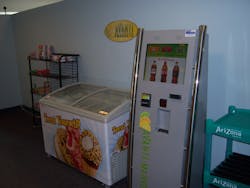
From coast to coast, new merchandising concepts are changing the face of automatic merchandising. Innovations such as cashless transactions, video touchscreens, remote machine monitoring and self serve checkout markets can be found in big cities and small towns in all geographic regions.
One of the most notable features of this revolutionary evolution is that contrary to what some would expect, small operators are driving much of the change.
Foley Food & Vending, a 7-route operation based in Norwood, Mass., offers a good example of a small company taking advantage of market changing technology to stay ahead of the competition.
The family owned and operated company came from humble beginnings in 1973 in the Boston, Mass. area. Today, under the second generation leadership of brothers Steve, Ken and Brian Foley, the company has survived the current economic downturn. Thanks to state-of-the-art management software and self serve markets, Foley Food and Vending continues to grow in the highly competitive greater Boston market.
The company has embraced technology in stages over the years. By investing in vending management software as it evolved, the Foley Food & Vending has positioned itself to introduce pre-kitting, cashless vending and self checkout markets.
Humble beginnings
The late Eugene Foley got into refreshment services almost by accident in 1973. Facing a layoff as a boiler operator, he purchased a small Canada Dry soda delivery route. Steve, the oldest son, was 14 at the time. Steve learned to repair the can soda machines his father serviced.
Six years later, the company had expanded into snacks, food and coffee and had grown to three routes, still operating from the family’s home garage. Steve continued to help his dad and another employee while he took business classes at the University of Massachusetts.
The company grew at a steady pace through the 1980s and moved into its present 10,000-square-foot building at an industrial park in 1985.
Foley Food & Vending won some big accounts by not crossing picket lines when certain accounts went on strike.
A big break came in 1996 when Aramark sold some of its business to another large operation that couldn’t meet service expectations. Foley was able to win some of these key accounts.
Early user of vending software
Steve Foley, the current president, didn’t hesitate to invest in vending management software. “I’ve always appreciated and embraced technology and what it can do for you,” he said.
In 1994, the company operated four routes, two of which were managed by family members. Foley did not think the company would be able to grow beyond this point without a more automated management system.
“How do you make that jump? It’s not easy,” Foley said. “Our goal was to manage a vending business where we had other (non-family) people fill the machines for us.” That year, he invested in Rutherford & Associates’ software. This was a DOS-based vending inventory management system that allowed Foley to track category level sales at the machine level in the warehouse.
It was around this time that another software company, Streamware Corp., was introducing a vending management software. Streamware also happened to be based in Norwood, Mass.
In 1999, Streamware offered to provide Foley its Windows-based software with DEX handhelds. The DEX handhelds allowed Foley to track cash meter readings and to track item level sales from the machine.
Streamware was willing to let Foley have the system at minimal cost to provide a beta test site, hoping Foley’s positive experience would provide a testimonial to other operators.
Foley instructed his best driver how to use DEX handheld to download data from snack and soda machines. “He bought into it,” Foley said. In time, DEX expanded to all routes.
Since not all of the machines reported DEX, it was necessary for drivers to input some of the data manually into the handhelds.
Foley made it a point to ensure that all newly-bought machines reported DEX.
He updated the employee handbook to include instructions on using handhelds. “Not only do they (route drivers) have to fill machines, they have to fill to our standards,” Foley said.
DEX-based line item reporting set the foundation for utilizing some of the new merchandising concepts introduced in recent years.
Evolving with technology
In 2005, Foley became one of the first operators in the country to embrace the Quickstore24 machine, an Internet connected machine with a video touchscreen that prints coupons and accepts thumb print payment in addition to other types of payment.
The Quickstore24 did not prove to be a big success (see sidebar on page XX), but it familiarized Foley with the benefits of remote machine monitoring. Because Quickstore24 does not require the vending operator to buy the machine, Foley has been able to operate several of these machines with minimal investment.
In 2007, with all routes reporting item-level sales, the company introduced pre-kitting routes in the warehouse. This came at fortuitous time. Pre-kitting allowed the company to reduce its inventory and delivery costs.
When the recession hit in 2008, the company was operating more efficiently due to pre-kitting.
Line item sales reports did not proven as useful a selling tool as he might have hoped, Foley noted. He said only the more sophisticated customers will take the time to look at these reports.
Pre-kitting did, however, help enable Foley to expand into self serve kiosk markets in the last year. This has proven a major success for the company.
The self serve market allows an operator to sell a much larger variety of products in open racks, coolers and bins than in vending machines. Filling the bins is much faster and easier than stocking vending machines, there is no cash float tied up in the machines, and there are almost none of the mechanical issues associated with machines.
“Customers like it,” Foley said of self serve markets. “Once they have it, they love it.”
All 11 of Foley’s self serve markets have been installed in new locations, making it hard to compare the sales to a traditional vending bank.
Foley said his average self serve market does between $30,000 to $35,000 per year in sales.
Self checkout markets: new convenience
In a self checkout market, the customer picks products from open racks, coolers and bins, then scans the UPC bar code for each product at the kiosk. They then pay with a single payment, using cash, a credit card or stored value pay card. The customer can add value to the stored value pay card with credit or cash. The kiosk alerts the customer when the stored value pay card needs to be replenished.
The front of the payment kiosks have video touchscreens that prompt the customer through the purchase process. The video touchscreens run programmed ads for some of the main product suppliers.
Surveillance cameras are installed at the location and monitored at Foley’s headquarters.
The upfront cost for an Avanti Market, the self checkout market Foley uses, is comparable to a traditional vending bank.
The touchscreen on the payment kiosk has proven to be a great promotional tool. Foley offers its own sweepstake promotions, giving customers a chance to win market credit.
Customers can also win market credit for referring another customer.
Foley is currently offering customers a 5 percent cash back if they add value to their stored value card with cash versus credit. Cash revalues allows Foley to escape the credit card company fees.
Most of the products do not have price tags. A customer can check the price of an item at the payment kiosk before buying it.
For items without bar codes, such as fruit, the touchscreen prompts the customer through a non-scan purchase.
More price flexibility
One benefit of the self checkour market is that unlike a traditional vending machine, the operator is not limited to certain price increments.
Foley warehouses a total of about 920 SKUs for his 11 self serve markets. A typical market offers around 400 SKUs. Products include large bags of snacks, submarine sandwiches, TV dinners, fresh fruit, boxed candies, boxes of K-Cups, utensil packs, single-use laundry detergent packs, and a variety of seasonal items.
The company also has single-cup brewers in the markets where customers serve themselves a cup of coffee for which they typically pay 75 cents.
“Things that normally wouldn’t sell through a vending machine are selling through the markets,” noted Brian Foley, customer relations manager.
While customers can pick up the products and read ingredient and nutrition information before buying, they can also view this information on the touchscreen.
The touchscreen also allows the servicing route driver to quickly view inventory needs while he is at the location. He can also input stales.
“The inventory has to be constantly monitored,” Brian Foley noted.
Because of the increased inventory, Foley has added to its warehouse staff, but this investment has been more than justified by the sales gain.
Warehouse organization critical
The Avanti Markets comes with its own software, and there is extra management time required for the markets. The system generates its own pick list.
Foley sources product from Vistar and a convenience store distributor.
Steve Foley noted that the warehouse has to operate with maximum efficiency to service the self checkout markets accurately. “The warehouse has to be 100 percent dead accurate in getting stuff into the field,” said Ken Foley, the vice president. “It has brought item level merchandising to a whole new level.”
Foley credits his warehouse inventory organization for being able to combine the vending and self checkout markets deliveries on the same vehicles. He has dedicated pickers in his warehouse for each main vend product category: cold drinks, snacks, and food (refrigerated and frozen). There are also pickers dedicated to the self checkout markets inventory.
Kevin Bailey, vice president of sales at Avanti Markets, said his company recommends dedicated drivers for servicing the markets. He said vending companies that assign the markets to vending drivers must advise them to take sufficient time in servicing the markets.
Bailey said about half of the vending operators that operate Avanti Markets assign dedicated drivers.
Even though there are now more products being delivered than prior to having the self checkour markets, pre-kitting has allowed for smaller truck loads. Foley has been able to downsize from trucks to cube vans. The vans carry refrigerated coolers to carry perishable items.
To improve item level merchandising, the company is in the process of investing in a “pick to light” system in its warehouse, whereby inventory moves along a mechanized line and is picked by pickers who are notified by lights how much of each item to pull.
The Avanti Markets has won several new accounts for the company.
The sales gain delivered by Avanti Markets allowed Foley to add an new route this past year.
So far, Foley has not paid any commission for an Avanti Market.
Foley recently installed an Avanti Market at an account with 500 workers. Because there are short meal breaks, Foley installed two kiosks to allow workers to buy their food faster.
Next goal: remote machine monitoring
The company’s experience with Avanti Markets and Quickstore24 has fostered an appreciation of remote machine monitoring (RMM). In both cases, Foley accesses a Website that collects data via RMM to get sales information and fill reports.
Hence, one of Foley’s next objectives is to introduce RMM to all of its vending machines.
RMM will provide more timely data than handhelds and it will eliminate the need for drivers to download data from all the machines.
Foley believes RMM will make it possible to implement dynamic scheduling, whereby routes are scheduled for service on an as-needed basis. The company has already introduced dynamic scheduling on a limited basis.
Foley is aware that dynamic scheduling does place new demands on management. Someone must monitor machine needs constantly or it may create uneven work loads for drivers.
Foley’s use of technology has required large investments for a company of its size. He credits his good relationship with a longtime banker.
With all of the money the company has been investing in technology, Foley is happy to report the company has been profitable. He sees rising product costs as the biggest challenge to his profitability at present and in the future.
He believes the investment in technology will allow Foley Food & Vending to be profitable for many years to come.
Operation Profile
Name: Foley Food & Vending Co.
Headquarters Location: Norwood, Mass.
Founded: 1973
Owner: Steve, Ken and Brian Foley
Number of routes: 7
Number of employees: 19
Software provider: Crane Streamware:
Annual sales: Not revealed
Foley pioneers QuickStore24
Foley Food & Vending Co. was among the first operators to embrace The Quickstore24, which was introduced in 2004. The high-tech vending machine was developed by Walker Digital LLC, which uses an unconventional business model, whereby the vending operator does not own the machine but pays Quickstore24 a percentage of the sales.
The Quickstore24 consists of a glassfront beverage machine and a glassfront snack machine connected by a green enclosure that features point-of-sale graphics. The divider between the machines contains the payment modules.
Quickstore24 initially offered a “2 for 1” combination soda and snack offer. That offer still stands, but there are now $1.25 offers.
The beverage machine has a touchscreen above the payment module, which accepts cash, credit and a Thumpass. Customers can check their credit Thumbpass balance at the machine or at a Website.
Customers can establish a Thumbpass by entering information on the touchscreen and making a thumbprint on a pad.
All sales data gets sent to a Website which the vending operator can access. The system separates cash from credit sales, but the Thumbpass sales are not separated from the regular credit card sales.
Brian Foley, vice president at Foley Food & Vending, said the Quickstore24 saved an account for the company. The customer wanted something different, and the Quickstore24 fit the bill.
Foley currently operates 11 of machines, but it does not see a big future for them.
Foley only operates one Quickstore24 as part of a vending bank. The rest operate independently in locations Quickstore24 solicited.
About the Author

Elliot Maras
Elliot Maras served as the editor of Automatic Merchandiser magazine from 1993 to 2012. To reach the current editor of Automatic Merchandiser and VendingMarketWatch.com, email [email protected].