Make buying easier for customers
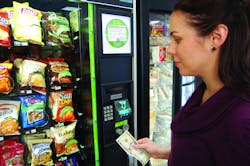
Vendors can do everything right – the right vending machine, right product selection, right service strategy, right product price point – and still miss out on a large percentage of sales. That’s because regardless of how much consumers want that drink or snack, they must have the means to pay for it.
And, in many cases, they do not.
The vast majority of consumers carry at least one credit card and larger denomination notes like $20 bills, which are commonly dispensed by ATMs. But only 50 percent or less of consumers carry $3 in coins or bills. In fact, 65 percent or more of consumers carry either $1 or $20 bills – the two notes that are the highest in circulation. According to the U.S. Mint, 31 percent of all currency in circulation today is the $20 bill and 46 percent is the $1 bill, while all other denominations have circulation levels well below 12 percent.
Despite money circulation levels, most vending machines out there today don’t accept higher denomination bills and/or credit cards. They only accept coins, $1s and possibly $5s. Frustrated, many consumers storm off from a vending machine without that desperately needed afternoon pick-me-up. Even worse, they are likely to give up on the vending machine permanently in favor of a convenience store or drive-thru chain that accepts all forms of payment.
Recent field studies found that higher denomination bill acceptance leads to at least a 20 percent increase in overall vending machine sales because it literally “unlocks consumers’ wallets” and makes it convenient to buy.
Why don’t machines accept higher denominations? Because operators have been concerned about changer starvation due to demands for large change amounts as change from payments made with high denomination bills.
Many operators report sales losses of 80 percent or more when a machine requires exact change only due to changer starvation. Bill changers, which change out large denomination bills, are expensive. Just one bill changer can cost as much as $1,200, require hundreds of dollars in change in the changer and hundreds more in replenishment funds.
Today’s cash recycling technology now allows operators to easily and cost-efficiently accept larger denominations, reverse customer attrition and drive sales.
Field-Proven Cash Recycling Technology
Cash recycling technology is not new, but it is just now hitting a significant adoption curve. In the first quarter of 2011, MEI sold more than 10,000 cash recyclers to vending operators since the technology was introduced in October 2008. Operators have reported success, citing various advantages – some expected, some not anticipated at all. Cost savings, sales lift, new profit opportunities, and an increase in customer satisfaction are among the highest reported benefits of cash recyclers.
The earliest adopters of the technology report sales lifts as high as 75 percent and return on investment (ROI) in as little as six months. The Coca-Cola Bottling Co. of Lehigh Valley, Pa., part of the ABARTA Beverage Group, for example, invested in cash recycling technology nearly two years ago and has experienced unexpected sales increases in all of its recycling-equipped vending machines.
“Customers have told me firsthand how thrilled they are to receive bills as change instead of dollar coins,” said Mike Gallagher, service manager for Coca-Cola Bottling Co. “Sales on those machines have increased, and the technology has been extremely reliable.”
Here’s a look at seven ways three vending machine operators – each with different vending operations – are using recycling technology.
Improve Customer Satisfaction
Consumers like choices and convenience. Cash recycling technology enables vending machines to offer customers more payment choices and encourages them to return to that machine again and again, confident that they can make a purchase with whatever is in their wallet. Also, providing change in paper bills more closely mimics purchases at traditional stores and restaurants.
Cotton Candy Vending of Denver, Colo., implemented cash recycling technology in more than 50 machines as a modular add-on to its existing note validators after realizing that it was losing customers who were only carrying $20 bills. The cotton candy sold in these machines cost $2, so customers who tried to pay with $20 bills would get $18 in quarters as change.
Customers were not happy, and change repositories were being wiped out in hours. Recycling technology has changed all that. According to Davy Clements, vice president of the Americas for Cotton Candy Vending, results have been promising with high sales lift and dramatically increased consumer satisfaction.
Cut Cash Management Costs
Cash recyclers lower cash management costs overall because machines with recyclers require far fewer coins for change. The 30 notes in the recycler replace far more than the equivalent of coins in the coin changer because the recycler refills more rapidly than coins.
MEI estimates that using a recycler will reduce the required float by at least $80. Also, recyclers eliminate the need for bill changers and their associated capital costs and required change funds.
Lastly, machines with recyclers require fewer cashbox collections because the cashboxes fill up slower. Recycler-equipped machines tend to collect high-denomination notes and pay out the smaller denomination notes as change.
It takes many more sales (and much more time) to fill a cashbox with high denomination notes. Cash recycling allows operators to maintain a lower total machine float by leveraging customer-provided bills as float.
Recycling also protects coin levels. Adding dollar tubes to machines requires a capital investment (over $100 per machine). Cash recycling technology eliminates the need for dollar tubes and their associated cash management costs.
Leveraging the high volume of $1 notes to keep the recycler drum filled is a better solution than chasing the local bank for more $1 coins, often requiring an added fee from the bank to obtain the $1 coins.
West Coast Vending in Oakland, Calif. had been experiencing a profit drain from having to frequently refill its machine’s dollar coin tubes. “We expected to get those dollar coins back from repeat customers,” said Matt Bauer, vice president of West Coast Vending. “Instead, less than 14 percent of those coins were being reused each week. Overall, this had real effects on our profitability.”
West Coast Vending implemented cash recycling technology and saw immediate results. “Cash recycling reduced the time required by drivers to restock the dollar coin tubes by 66 percent, and allowed us to eliminate half of our dollar coin tubes in each machine. We also experienced a 10 percent sales lift per machine, with some as high as 15 percent.” Bauer said that the investment paid for itself in less than six months and he plans on adding recyclers to each bank of machines on all routes.
End Changer Starvation
Studies shows that machines slip into “exact change” mode more than one third of the time – essentially a “down” machine. Consumers rarely carry exact change today, making it literally impossible for customers to buy from those machines 33 percent of the time. Cash recyclers eliminate this problem because they reduce exact change scenarios. There are fewer coins required for making change because $1 or $5 notes can be used instead.
Increase Sales Volume
Consider situations when the consumer wants to purchase more than one item from the machine (aka bundling of product or multi-vend). A mother wants to buy drinks at an after-school soccer game for her two kids but only has a $10 bill, and one $1. The vending machine only accepts $1, and maybe even $5 bills. In this case, she cannot make a purchase of two sports drinks for her two kids.
But if the machine accepted higher denominations, then this soccer mom could use her $10 bill to buy the drinks, and maybe even a snack, too. As a result, the vending machine has tripled its sales revenue rather than losing out because it was not equipped with a cash recycler so that it could efficiently accept higher denominations.
The improved customer experience derived from recycling clearly drives sales lifts for operators. Consumer awareness and confidence in the technology builds over time and leads to stronger vending loyalty from vend patrons.
Achieving Sales Lift
Dozens of field studies show that vending machines experience a sales lift just by enabling the acceptance of $5 bills. Sales multiply further with the acceptance of larger denominations, especially in vending machines where the per-item price is higher than the average $1.25.
Buffalo Rock Co., the Birmigham, Ala.-based Pepsi bottler and vending operator, tested this theory by installing a cash recycler in 20 machines across three regions. Buffalo Rock compared sales data based on the previous year’s figures to determine the impact of cash recyclers, and found sales lifts ranging from 15 percent to more than 75 percent.
“Customer convenience is a major goal for us, and a sales lift confirms the reliability of recycling technology,” said Mike Bunt, general manager of corporate marketing equipment at Buffalo Rock. “In most cases, we achieved at least a 15 percent sales lift since installing the recyclers with virtually no jams of service problems. We will continue to integrate recyclers into our other vending machines. This is a huge win for us.”
Prevent Customer Attrition
Hand-in-hand with improving sales lift, cash recycling technology also helps drive sales by creating loyal customers who are not forced to find alternative retail sources that will accept what’s in their wallet or pocket.
There are more convenience stores, super gas station stores and alternative retail channels in operation than ever, most of which now accept debit, credit and large denominations. Consumers have many other easy options for buying snacks, beverages, candy, etc. In fact, the number of U.S. cC-stores increased 1.2 percent in 2010 to more than 146,341 – the highest number of stores ever recorded. This doesn’t even take into consideration all of the other types of retail outlets.
A Way to Up-Sell
An unexpected advantage to cash recycling technology is the newfound opportunity to sell higher-priced products such as sandwiches and specialty sports drinks. West Coast Vending, Buffalo Rock, and Cotton Candy Vending all recognized how the ability to efficiently accepting higher denomination bills in their vending machines opens up new product offering doors. No longer hindered by cash management constraints, vending machines equipped with cash recyclers are limitless in their product selection. This is especially true when also equipped with credit card readers.
Build for the Future
Today, 77 percent of Americans age 18 or older have at least one credit card. Many consumers claim to use their credit and debit cards much more often than cash – it’s their go-to payment of choice when their wallets are thin. Consequently, combining a cash recycler with a credit card reader enables vendors to completely unlock consumers’ wallets…never having to turn away a customer from limited payment options again.
This benefit translates in to hard numbers, too. Consider this scenario – for a machine generating $60 per week in gross sales (with a $1.25 vend price), operators will see a $615 per machine sales lift annually if they use both a credit card reader and recycler.
With a higher average vend price of $2.50, operators can increase sales annually by $2,349 per machine. Multiply that across an entire region of machines and the revenue growth is. See Figure A for a complete breakdown of cost gains with a cash recycler and credit card reader technology combination.