Beta test brings strong results for interactive Diji-Touch machine
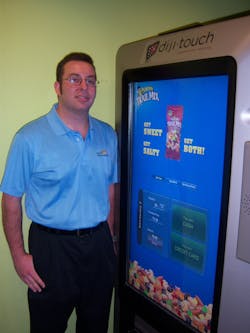
Good news! The vending experience of the future will be an engaging one for consumers. Not only will they know the nutritional content of the product they buy before making a purchase. The process of reading the nutrition information will be exciting, as they are enticed by a colorful display of graphic images that scroll across a screen that resembles a giant smart phone.
This is not fantasy. For many consumers in the Northeast, it is already reality, as the Diji-Touch machine, an Internet-connected machine with a 46-inch touchscreen that makes the vending experience more interactive for consumers, has dazzled 20 locations served by Canton, Mass.-based Next Generation Vending & Food Service Inc.
Next Generation recently completed an 8-month beta test for Diji-Touch, a partnership of Kraft Vending & OCS, Crane and Samsung, including colleges, health care facilities and industrial locations. All parties believe the test has been very successful.
The next step will be a pilot test among independent vending operators, according to Kraft. The long-term goal is for the machine to be available to operators nationwide.
Next Generation, which was selected for the beta test because of its technological expertise, plans on purchasing more Diji-Touch machines, based on the results to date.
The machine, which Kraft and Crane both displayed at the National Automatic Merchandising Association OneShow in 2010, has undergone some changes during the beta test. Next Generation and Kraft are both awaiting reports from researchers who are analyzing data from the beta test.
Digitas LLC, a digital advertising company, is determining metrics such as how long consumers are viewing nutrition data before making a purchase, and what relation exists between nutrition reading and purchasing. Digitas can determine these metrics because each time a consumer touches the LCD screen a file is recorded.
Nielsen Strategic Media Service, meanwhile, has interviewed consumers and will determine how consumers use the machine and how they perceive it. (See sidebar, page XX.)
A long-term goal is to use the Diji-Touch as an advertising medium. While the machine in its current stage uses promotional advertising to encourage vending sales, the system also has the potential to carry paid advertising, offering “passive” income to vending operators.
Development ongoing
The Diji-Touch machine, besides offering a more interactive buying experience, marks a new type of development process for vending. Unlike other innovations that are tested and then brought to market, Diji-Touch is an ongoing process. This is because it uses a technology – liquid crystal display digital video – that is still evolving.
The Diji-Touch mimics a traditional glassfront snack machine in that it displays a grid of product facings. The first difference is that instead of displaying actual product, the screen presents a grid of colorful graphic icons representing the products.
Once the consumer touches an icon to make a selection, a larger image of the product appears on the screen, prompting the consumer to “spin” the image. The image of the product rotates in place in the center of the screen, allowing the consumer to view the package from different angles. The consumer can then choose a view of the ingredients, the nutrition data, or move on to the actual purchase process.
The touch prompts lead the consumer through the purchase process, offering a choice of payment method: cash or credit. At the end, the screen displays the sale information and asks the consumer if they’d like to make another selection.
These text prompts appear on a rectangular image in the center of the screen against a solid background. The screen is highly versatile and can include an advertising banner or virtual images of mascots such as Mr. Peanut.
The user can even adjust the product grid so the top and bottom rows can switch position, allowing someone who is visually impaired to view the top rows at eye level. This feature makes the machine ADA (Americans with Disabilities Act) compliant.
The screen displays programmed advertising when it is not in use.
Service technicians use the touchscreen to access service menus.
In a recent 8-month period, Next Generation placed all 20 of its Diji-Touch machines in existing locations, where they replaced glassfront snack machines. The company wanted to place the machines in existing banks in order to see how the machine can be integrated into its operations. This has also given the company the ability to compare the Diji-Touch’s performance against a traditional snack vender.
A controlled beta test
In introducing the Diji-Touch machines to customers, Next Generation agreed to keep most of the same products in the machines, and at the same prices, noted John Hickey, senior director of management information systems at Next Generation.
Because the Diji-Touch has 54 facings, the machine offers more variety than a traditional vender.
Hickey said the Diji-Touch has roughly doubled the sales of the older vender in most locations.
“It has significant lift to really make business sense,” noted Frank Guzzone, Kraft Vending & OCS business developing manager, strategy and innovation.
Next Generation has been able to integrate the Diji-Touch into its existing routes fairly easily, largely because the company was already pre-kitting its routes using remote machine monitoring.
Where most of Next Generation’s machines send DEX information by means of a Crane Streamware telemeter, the Diji-Touch machine sends the DEX information to Next Generation via an imbedded computer.
All of the ingredient and nutrition information, as well as the digital graphics, have been provided to Next Generation by Kraft. When new products are added, the product manufacturers send these materials to Kraft.
Hickey said adding graphics and information, known as “assets,” has not been difficult for Next Generation.
Seeing that Diji-Touch is a Kraft initiative, the question naturally arises: Does the vending operator have complete freedom to choose the products? Hickey said this has not been an issue for Next Generation.
“Data mining” is part of the Diji-Touch initiative. The data mining function is being managed by Blue World Inc., the vend data collection and rebate management provider.
Hickey said Next Generation has had to increase its stock keeping units (SKUs) to accommodate the Diji-Touch machine, but not significantly.
Managing stock keeping units paramount
The high level of SKU-level data that gets communicated to the customer by Diji-Touch makes SKU management critical, Hickey said. While the company was already focused on SKU management when it introduced pre-kitting, the Diji-Touch test has forced the company to take SKU management to a new level.
“We have learned a lot about SKU discipline,” Hickey said. “In this (Diji-Touch) machine, you can’t allow a consumer to not get the exact product that shows up on the screen. That SKU discipline has to happen all the way through your supply chain.”
To this end, Next Generation has introduced the LightSpeed “pick to light” product picking in its Middleton, Mass. warehouse. This is an automatic picking system that uses lights to alert product packers how much product to pick from a moving row of product bins.
Hickey said one takeaway for him is the important role that computer skills will play in the future of vending management.
Mike Keating, Next Generation’s client relations manager for the Boston area, said he is surprised by the degree to which college students are reading the nutrition information on the Diji-Touch machine.
Impact on the customers has been significant.
“The excitement level was greater than I expected,” noted Darryl Perkins, Next Generation’s senior program manager for information systems. While the excitement has been strongest among children, it has also been noticeable with adults, he said.
“This is a real injection of innovation to the industry,” Hickey said.
Step two: pilot test
One of Kraft’s next moves will be to determine a business model for vending operators, Guzzone said. While the intention is to sell machines to operators, Guzzone said Kraft is looking at ways to subsidize the costs so that the purchase of the Diji-Touch is comparable to other snack machines.
Another goal is to be able to use the machines as an advertising medium. Guzzone envisions this function being handled by an outside party. “The operator doesn’t have time to sell advertising,” he said.
While it will be several months before Kraft has the information needed to develop a model for commercial advertising for Diji-Touch, the promotional advertising Kraft has already done for its own products in the machine has impacted the sales of those items. For these items, there is a banner that appears across the top of the screen when the item is selected.
Other innovations are also in the works for Diji-Touch.
The machine has audio speakers that can add a sound component, thereby enhancing the interactive experience, Guzzone said.
The machine also has an imbedded camera that can be used for several purposes.
One immediate benefit the camera can provide is to help identify anyone who vandalizes the machine.
The camera, by photographing users, will also be used to help Kraft gather demographic information on users.
In addition, Guzzone said the camera will allow the machine to offer creative promotions; users will be invited to have their pictures used in Internet promotions.
The field of interactive touchscreens continues to evolve along with mobile commerce and Internet commerce. Hence, the Diji-Touch machine will find new uses as it rolls into the vending market.
In the near term, Kraft hopes to formalize a business case for vending operators. Guzzone said it is reasonable that 100,000 machines could be installed in a 5-year period.
The Diji-Touch machine, while still in its pilot stage, is reinventing the vending experience.
Consumer feedback positive, paving way for new advertising medium
Recognizing that high cost of the Diji-Touch Machine, Kraft Vending & OCS from the very outset of this initiative has sought to use paid digital advertising to offset some of the costs. This has taken the Diji-Touch into a new and evolving field of digital signage.
To develop a business model that would allow the Diji-Touch to play such a role, Kraft enlisted the Nielsen Strategic Media Service to study consumer perceptions of the machine.
“The ‘home run’ would be a device that increased sales of the products contained within, that enhanced the environment or the experience of both users and non-users within the environment, and which could help support the financial investment of a rollout,” said Paul Lindstrom, senior vice president at Nielsen.
At this writing, Nielsen was in the process of completing 375 consumer interviews.
Lindstrom said that while the sample size to date is small, feedback has been very positive. Lindstrom, who has been researching 20 different environments for digital signage advertising, said the Diji-Touch has been one of the most promising environments to date.
“The ‘notice levels’ are extremely high,” Lindstrom said regarding response to Diji-Touch.
A key feature of the Diji-Touch experience, Lindstrom said, is the amount of time the consumer is focused on the experience. “They (Diji-Touch) are having very positive feedback from the people that we interviewed,” he said.
Lindstrom noted that advertising agencies are anxious to develop the digital signage medium since it offers a more targeted audience than traditional advertising media.
“It (Diji-Touch) becomes a dual revenue stream,” Lindstrom said.
About the Author

Elliot Maras
Elliot Maras served as the editor of Automatic Merchandiser magazine from 1993 to 2012. To reach the current editor of Automatic Merchandiser and VendingMarketWatch.com, email [email protected].