Washington State Leader’s 3-Pronged Battle Plan: Technology, Sustainability, Nutrition
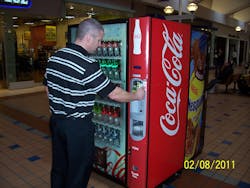
One benefit of being owned by a larger company is having the resources to invest in new technology. This advantage has not been lost on Coca-Cola Vending Yakima & Tri Cities, which operates full line vending in Yakima and Pasco, Wash. The vending operation has aggressively expanded into cashless readers, DEX handhelds, healthy initiatives and a multi-faceted sustainability program, all of which have proven popular with customers.
The company is owned by The Dolsen Companies, a Yakima, Wash.-based firm.
Yakima and Pasco have suffered higher than average unemployment during the recession, but sales have started to improve, thanks to a reviving agriculture industry. The vending operation has found it important to offer new benefits to win customer loyalty.
The Pacific Northwest has also been highly concerned about nutrition and the environment. Hence, Coca-Cola Vending’s initiatives in both of these areas have been helpful winning new customers.
Coca Cola Vending was formed in 2006 when its parent company combined the vending division of its beverage bottling operation, Coca Cola Bottling, with its full line vending division, Automat Vending. One of the bottling organization’s two vending routes remained a dedicated beverage route while the other one was integrated with Automat Vending’s 14 full line routes. The dedicated beverage route serves locations that only have beverage machines.
Prior to 2006, the two divisions actually competed against each other. The bottling company operated two beverage vending routes while Automat Vending operated full line routes.
Automat Vending was founded in 1954 and was acquired by the Dolsen Companies in 1986.
Jeff Hemp, who currently serves as on-premise business development manager, joined Automat Vending in 1987 as a vending route driver. The company was growing at the time.
Hemp became the route supervisor in 1991 when the company grew to seven full line routes, including one dedicated food route. Around this time, the company added a second branch in Pasco, which is about 85 miles south of Yakima.
The company experienced a difficult time in the early and mid 1990s due to the Alar scare. Alar is a pesticide used on apples that was believed to be associated with cancer. The alarm was reported on “60 Minutes” in 1989 and resulted in major layoffs through the mid 1990s.
Business began to recover in the late 1990s, and in 1995, Hemp relocated to Pasco to manage the branch which had grown to five routes. At the time, both branches were expanding into OCS.
Two years later, Hemp was promoted to general manager and moved back to Yakima, where he oversaw the introduction of new software and handheld computers. The company was interested in improving its accounting and inventory management and tracking item level sales.
Company introduces DEX
Following a test using Rutherford & Associates’ vending management software, the company began having all of its drivers download DEX on its cold drink machines. The drivers manually entered the DEX data from the snack and food machines. (MEI acquired Rutherford in 2001.)
The item level accounting helped identify the best sellers. Hemp knew which items to assign double facings.
“It (DEX) gave us the ability to better market to each customer,” Hemp said. “It helped us to merchandise better, without taking complete authority out of the drivers’ hands.”
The company used the item level data to design planograms for the cold drink and snack machines. The drivers continued to select all of the products for the food machines from the warehouse.
Drivers can still accommodate customer requests for products that are not in the planograms, Hemp noted. The driver needs to enter the request on their handheld.
The item level tracking proved especially helpful as the company began to add more glassfront cold drink machines. Hemp said the glassfront beverage machines on average boosted sales by about 30 percent.
The item level reports have helped supervisors analyze sales better. “We actually use MEI to figure out where we need to get price increases,” he said.
With the item level reports, Hemp has been able to track the success of new products faster and more accurately. Because customers are asking for healthier options in the machines, he reasoned that he could offer these options with the understanding that he would remove them if they did not sell well.
Healthy vending finds success
In 2007, Coca Cola Vending began offering the National Automatic Merchandising Association (NAMA) Fit Pick program in schools, and eventually to business and industrial accounts as well.
Some accounts offered to subsidize the Fit Pick items. Hemp said some Fit Pick items carry a 20 percent discount. The company uses the stricter of the two Fit Pick standards, which includes caps on sodium, trans-fat, and calories.
One industrial account wanted to offer an incentive to employees to buy the healthier options. The account required Coca Cola Vending to provide item level sales reports to send along to their parent company. This particular account follows standards from the National Institutes of Health.
The DEX reports alerted Hemp to the advantages of new technology. He attended trade conventions and went to as many technology seminars as possible.
Hemp attended the NAMA executive development program at Michigan State University in 2005. Some of his employees attending NAMA supervisory training held at NAMA expos, all of which he finds extremely valuable.
While he has kept an open mind about new technology, Hemp has always tested new tools before making major investments.
The company has DEXed its cold drink machines but not other machines. Drivers are required to enter sales from snack and food machines manually into their handhelds. Hemp is still considering DEXing the snack machines.
Nor has Hemp been sold on the benefits of remote machine monitoring (RMM).
In 2007, a vending management company required him to install RMM devices in a few accounts.
Hemp said he believes RMM provides benefits to operators in certain situations. “It didn’t fit us,” he said.
Cashless proves successful
One technology that has proven successful for Hemp has been cashless readers. He became interested in cashless after hearing the experiences of other vending operators.
In 2008, he began testing an MEI card reader in cold beverage machines with USA Technologies Inc. processing and settlement service. USA Technologies combines the processing charges with the credit/debit card issuer’s transaction charges in one monthly fee.
The USA Technologies Website allows Hemp to compare the cashless sales to cash sales.
He installed the first card reader in a college, and the students immediately began using it. He then began adding card readers to snack and beverage machines in work sites, call centers and shopping malls.
In comparing the sales in a machine with a card reader to a machine without a card reader at locations of similar size, he found the card reader delivered 20 percent more sales.
At shopping malls, as much as 30 percent of the sales are credit purchases, Hemp said. “At one particular account, 70 percent of the sales are credit,” he noted.
In public locations, customers start using card readers immediately, Hemp said. In captive locations, it takes a month or two for customers to begin using them. “It takes 30 to 60 days for people to realize the machine will take a credit card,” he said.
“If specifically chosen accounts don’t grow by at least 10 percent (with cashless), I would be surprised,” Hemp said.
More recently, he has added cashless readers to some hot beverage machines. “It’s really doing well,” Hemp said. He expects that cashless will eventually become the dominant form of payment in vending.
The company has 150 cashless readers and is adding more.
Hemp said the cashless option has been especially helpful in raising prices. He is currently charging up to $1.25 for large size confection candy and some pastries, up to $1.75 for some bottle beverages, up to $3.00 for fresh food and $6.00 for frozen TV dinners.
He has also found it helpful to have bill recyclers. Machines with bill recyclers accept $20 bills.
Sustainable initiative proves popular
Sustainability has been another customer hot button for Coca Cola Vending.
Recycling has proven very popular with many accounts and is part of a multi-faceted sustainability initiative the company offers to customers. “Our carbon footprint is very important,” Hemp explained.
Coca Cola Vending offers 5-foot high containers shaped like a Coke bottle for plastic bottles and aluminum cans. “While delivering to vending machines, our drivers pick up the bagged used bottles and cans, bring them back, then they go to a recycling center,” Hemp said. “This is something the competitors do not do.”
Energy efficiency is another part of the sustainability program.
The company has been one of the more aggressive vending operations to offer VendingMiser energy saving devices from USA Technologies. Over the last seven years, Hemp estimates the company has installed up to 300 VendingMisers in cold drink machines.
The VendingMiser is an effective selling tool, he noted. There is no cost to the customer.
The company has also been buying machines with LED lights, which last longer than fluorescent lights.
Hot drink machine shows promise
Hemp is also excited about the Seattle’s Best Coffee machine. “Seattle’s Best Coffee is well known in the Pacific Northwest,” he noted. They tested one machine with a card reader, and the machine did twice the sales of a typical hot beverage machine.
The Seattle’s Best machine has a price points as high as $2.75 for a 16-ounce up. Hemp plans to order more of these machines. “I think this is going to help revive vended coffee,” he said.
On the OCS side, he has found the Tully’s and Starbucks fractional packs good additions to the Folgers, Maxwell House and Gavina fractional packs.
The resources of the bottling operation have been helpful to the vending company’s ability to invest in technology and to offer recycling. The bottling operation has over 120 employees, nearly four times as many as the vending operation.
For special events, he provides customers with postmix fountain machines for free.
Bottling arm offers synergies
The beverage bottling operation provides some key synergies to the vending operation. The companies share warehouse space, office space and repair space. They also share repair technicians and office staff.
There is also a key marketing synergy; Hemp always knows what products the bottling side is promoting.
A few years ago, he began using Powerpoint, which he finds does effective presentations for vending proposals. When pitching a new account, he takes a picture of the existing vending bank, then does a mock up of how the bank would look with his machines.
There are also better benefits and career opportunities that a vending company of similar size might not be able to offer.
Hemp is optimistic about the future. The agriculture industry has done well for the last two years.
The customers’ acceptance of cashless readers makes him more enthusiastic, and the response to the company’s healthy eating and sustainability programs has also encouraged him.
“Great employees and great leadership from our management helps us to succeed,” Hemp said. “I’m lucky to be with such a group.”