Can Starbucks revive hot beverage vending?
Coffee may the hottest thing happening in refreshment services today, but when it comes to hot beverage vending machines, most operators will change the subject.
For many, the hot beverage machine represents the industry’s past. Coffee vending was part of the traditional vending bank in a factory location. The type of location which has given way to smaller work sites with more professional clientele.
So holds the conventional wisdom.
But for those who aren’t swayed by conventional wisdom, coffee vending machines may be making a comeback.
The coffee vending machines coming on the scene nowadays bear little resemblance to the generic machines of the past. Instead, a new generation – scarce though it may be – bears brand names of some of the same blends that today’s coffee consumers are paying top dollar for at coffee houses.
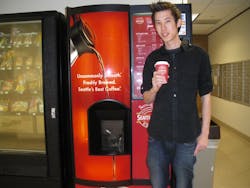
Starbucks, the nation’s pre-eminent specialty coffee – has tabbed the vending industry as part of its new effort to bring specialty coffee to the masses. The initiative began last year with the introduction of the Seattle’s Best Coffee machine, which the company displayed at the National Automatic Merchandising Association OneShow in Chicago.
Seattle's Best Coffee (SBC), part of Starbucks Corp., launched its first integrated, multi-channel advertising campaign debuting the brand's "Anywhere Great Coffee is Needed" strategy. The first phase of the campaign includes a series of online TV ads, billboards, wild postings and digital and introduces a bold new approach to premium coffee.
Jenny McCabe, director of communications for SBC, said the dedicated SBC vending machine is part of the company’s effort to make premium coffee accessible to consumers.
In addition to the vending initiative, SBC has partnered with AMC Theaters, Burger King, Subway, cruises, colleges, and foodservice contractors.
Increasing points of distribution
The initiative has boosted the points of distribution for SBC coffee from 3,000 to 40,000, McCabe noted. The company plans to more than double this to 100,000.
The SBC machine is a Crane National Vendors 677 Hot Drink Center with dual bean grinder, programmed gram throw and steep timing, and branded graphics for the machine, the cups and the cup sleeves. There is also an SBC retrofit kit available from Crane for older Hot Drink Centers.
Half of the machines placed to date have gone in business and industry sites, followed by health care (18 percent), military (18 percent), education (8 percent), entertainment (3 percent) and professional office (3 percent).
“We definitely see this as changing consumer perception of vended coffee,” said Maggie Rogers, director of national accounts and product supply initiatives at Crane.
The Navy Exchange Service Command (NEXCOM) currently operates 11 SBC machines in barracks, training schools and at its headquarters office building in Virginia Beach, Va.
NEXCOM plans to add a minimum of 20 more in early 2011, said Gerard Fantano, NEXCOM vending branch manager. Overall, they have been very successful.
NEXCOM first placed a coffee machine with a bean grinder in a site with more than 500 personnel in 1992. However, the machine generated less than $50 per month and the top seller was hot chocolate.
In introducing the SBC machine in 2010, NEXCOM priced a 12-ounce cup at $1.00. Similar size national brand cups at retail cost $1.50 to $1.80.
SBC machine builds sales
The SBC machine generated more than $400 in the first 10 days, Fantano said. "It is noteworthy that headquarters personnel have other coffee options such as three OCS coffee stations and a number of individual coffee makers throughout the building," he noted.
The SBC machines installed at the Great Lakes Naval Command in Great Lakes, Ill. delivered 14,000 unit sales compared to 6,800 the previous year for the same period of time, Fantano said. At one school alone, the SBC machine did $9,176 in three months compared to $1,840 in the previous machine.
At a barracks, the sales in a 3-month period went from $1,477 to $2,128.
At an indoctrination center, sales in a 2-month period rose from $514 to $1,521. At yet another site, sales for a month went from $340 to $745.
An analysis found that the SBC machines delivered a 50 percent sales increase over the previous coffee machines.
Fantano said his team wanted to revitalize the vend coffee category.
"Combining a national brand like Seattle's Best with today's bean grinder coffee machine technology was the right thing to do," he said.
Newcomer finds success
One relative newcomer to vending has also learned the benefits of the SBC machine.
Andrew Davis, 22, got into vending two years ago on a part-time basis with some soda and snack machines. One of his first accounts was a 15-floor office building with a snack machine, soda machine and a countertop coffee brewer in the lobby. The building manager paid for the coffee.
When the building was sold, the new owner said they didn’t want to pay for the coffee anymore, but they still wanted coffee. Davis reasoned he needed a coffee vending machine.
Davis bought a fresh brew, dual cup machine with generic graphics. He charged 70 cents and 80 cents for 12- and 16-ounce cups. He was not pleased with the sales.
When Davis saw the SBC machine on the Crane Website, he was intrigued. “It just made sense,” he said. “They (the customers) see a name brand coffee they can trust. It’s more of an experience.” He ordered an SBC retrofit kit and paid a technician to install the bean grinders, programmed control boards and graphics. He was able to source the product at Vistar.
Since he decided he would have to raise the price points beyond a dollar, Davis also installed a USA Technologies credit card reader.
The first day the SBC machine was up and running, Davis put the machine on free vend and passed out a survey to employees to make them aware of the machine. The employees loved the coffee.
Davis then raised the prices to $1.00 and $1.25 for the 12- and 16-ounce cups, respectively, and added flavored coffee for $1.50 and hot chocolate for $1.75. The customers didn’t seem to mind paying the higher prices.
“It was an instant difference,” Davis said. “The sales on it have more than tripled.”
The location’s sales doubled as a result of the SBC machine, said Davis, who expects the location to bring in $40,000 in annual sales.
About 15 percent of the sales are credit purchases, he said.
One veteran operator, Steve Hall, Sr., who owns Firelands Food Systems Inc. in Sandusky, Ohio, has been pleased with the performance of the SBC machines in hospitals. “It’s a brand recognition thing,” Hall said. “It’s something the vending industry needs.”
Hall saw the SBC machines at the NAMA OneShow and has purchased some machines new and has also opted to retrofit some existing machines. Overall, the machines have delivered an 18 percent sales increase.
Hall credited the increase to both unit turns and higher prices. He raised his prices from 75 cents and $1.25 to $1.25 and $1.75 for his 12- and 20-ounce cups.
After witnessing the performance in hospitals, Hall plans to place some SBC machines in office locations, but not blue collar accounts.
The SBC machine is not the first branded coffee machine to be introduced to the vending trade. But for more operators to embrace the concept, they will need overcome their historic objections to branded machines. They will also have to overcome their current hesitation to reinvest in an industry segment that has suffered disproportionately in recent years.
Vending operators have objected to branded machines since they are required to use one brand of coffee that is often more expensive than other coffee. The freedom to use whatever coffee they want has traditionally trumped the benefits of having a national brand.
In recent years, with the decline in high population accounts, operators have removed hot beverage machines. In many instances, they have replaced them with OCS.
Those operators who have worked with the SBC machine claim it provides them a way to distinguish themselves in the market and at the same time, meet the needs of consumers who want premium coffee at work.